Tesamorelin vs Melanotan II — Research Comparison UAE: Which Peptide Belongs in Your Lab Protocol?
Why UAE Research Teams Are Asking This Question
Research peptide procurement in the UAE has matured considerably. Labs in Business Bay, Dubai Internet City, Sharjah's academic corridor, and Abu Dhabi's health cluster no longer arrive with a single compound name and a vague brief. Today's procurement decisions are driven by comparative mechanistic rationale, evidence quality assessment, and protocol defensibility — not just availability or price.
Tesamorelin and Melanotan II appear on the same shortlist at some UAE research institutions because both are synthetic peptide analogs with structural modifications relative to their endogenous templates, and both attract interest from researchers exploring body composition, adipose biology, or integumentary signalling. That surface similarity evaporates immediately once you examine the receptor pharmacology. These two compounds work on separate biological systems, carry fundamentally different evidence portfolios, and serve very different research designs. Conflating them is a procurement error that wastes bench time and budget.
This comparison is written for principal investigators, research procurement teams, and lab managers across Dubai, Abu Dhabi, Sharjah, and the wider UAE who need a grounded, no-fluff breakdown before committing to either compound. Nothing here constitutes clinical guidance — all framing is strictly research-use context for in vitro and preclinical investigation.
Mechanism at a Glance: GH Axis vs Melanocortin System
The first thing a research team needs to understand is that choosing between tesamorelin and Melanotan II is not a matter of preference or potency — it is a matter of which biological question you are asking. These two peptides target different receptor families in different tissues and produce mechanistically unrelated downstream effects.
Tesamorelin — GHRH Analog Targeting Pituitary Somatotrophs
Tesamorelin is a synthetic analog of endogenous growth hormone-releasing hormone (GHRH), comprising the full 44-amino-acid sequence of native GHRH with a trans-3-hexenoic acid moiety conjugated to the N-terminus. This structural modification confers resistance to dipeptidyl peptidase IV (DPP-IV) enzymatic degradation, meaningfully extending plasma half-life relative to the native peptide without altering receptor binding specificity.
In research models, tesamorelin binds selectively to GHRH receptors on pituitary somatotroph cells, stimulating pulsatile GH secretion and downstream IGF-1 production through the endogenous hypothalamic-pituitary-somatotropic axis. This is mechanistically distinct from direct GH administration: tesamorelin preserves the physiological feedback architecture of the GH axis, including IGF-1-mediated negative feedback on GH pulse amplitude. For research teams interested in axis-level modulation rather than receptor-level saturation, this distinction is consequential to protocol design.
Melanotan II — Melanocortin Receptor Agonist
Melanotan II (MT-II) is a cyclic synthetic heptapeptide analog of alpha-melanocyte-stimulating hormone (α-MSH). Its defining pharmacological characteristic is non-selective agonism across melanocortin receptors MC1R through MC5R — a receptor promiscuity that generates a broad range of downstream effects in preclinical models. MC1R governs melanogenesis in melanocytes; MC3R and MC4R are expressed in hypothalamic nuclei linked to energy balance and autonomic tone; MC5R appears in exocrine tissue.
This broad binding profile is simultaneously what makes MT-II interesting to researchers studying melanocortin pathway pharmacology and what complicates mechanistic interpretation of results. Observed effects in research models are difficult to attribute to a single receptor subtype without complementary selective antagonist controls. MT-II research teams are, in practice, studying the aggregate melanocortin agonism response — or they need to design around this with receptor-subtype-selective blockers as co-treatments.
| Parameter | Tesamorelin | Melanotan II |
|---|---|---|
| Peptide class | GHRH analog (44 AA + N-terminus modifier) | Cyclic melanocortin agonist (7 AA) |
| Primary receptor target | GHRH-R (pituitary somatotrophs) | MC1R–MC5R (non-selective) |
| Biological system engaged | GH / IGF-1 axis | Melanocortin / pigmentation / hypothalamic autonomic |
| Receptor selectivity | High (GHRH-R specific) | Low (pan-melanocortin) |
| Peer-reviewed clinical evidence | Strong — NEJM, JAMA, Lancet HIV | Limited — predominantly preclinical |
| UAE research vial format | 5mg & 10mg lyophilised (REVIVE LAB UAE, in stock) | Contact REVIVE LAB UAE for availability |
| Protocol evidence quality | Multiple large RCTs, longitudinal follow-up | Rodent and in vitro model basis |
Tesamorelin's Evidence Portfolio: What the Published Literature Actually Shows
For any UAE research team building a protocol rationale document, tesamorelin's published record is exceptionally strong by research peptide standards. Four landmark peer-reviewed publications span nearly fifteen years of follow-up data — an evidence density that is genuinely uncommon in this compound class and that provides research teams with a deep mechanistic baseline to reference.
The 2007 Falutz et al. study in the New England Journal of Medicine was the first large-scale randomised investigation of tesamorelin's effects on trunk fat in a defined study population, demonstrating statistically significant reductions versus placebo with a characterised safety profile. The study design used a parallel-arm randomised controlled format — the gold standard for mechanistic isolation — which gives subsequent researchers a reproducible comparator baseline.
The Falutz et al. continuation trial (also NEJM, 2010) addressed the critical follow-on research question: what happens to observed parameter changes when tesamorelin administration ceases? The findings were mechanistically coherent with the compound's GHRH-axis dependence — changes tracked with active administration periods — and provided research teams with important data on the reversibility and axis-dependence of tesamorelin's effects. For protocol design purposes, this reversibility data is directly relevant to washout period planning in multi-arm studies.
Stanley et al. (JAMA, 2014) refined the research lens by examining visceral adipose tissue as a distinct anatomical and metabolic compartment rather than treating trunk fat as a homogeneous target. This distinction has genuine research relevance: visceral adipose tissue maintains different inflammatory cytokine secretion profiles, different lipolytic kinetics, and different relationships to insulin receptor sensitivity compared with subcutaneous adipose depots. Tesamorelin's signal in this VAT-specific analysis gave downstream researchers a more granular mechanistic target.
Stanley et al. (Lancet HIV, 2019) extended the evidence to long-term follow-up, providing durability and safety characterisation that shorter trials structurally cannot. For UAE lab teams designing multi-cycle or longitudinal observation protocols, this is the paper that justifies extended research designs — it provides the long-arc data that single-cycle studies cannot.
No comparable evidence chain exists for Melanotan II. MT-II research teams are working primarily from rodent model and in vitro mechanistic literature. That is legitimate foundational research — but it sits in a very different epistemic position relative to protocol justification, particularly for institutions that require ethics committee or IRB-level documentation of compound rationale.
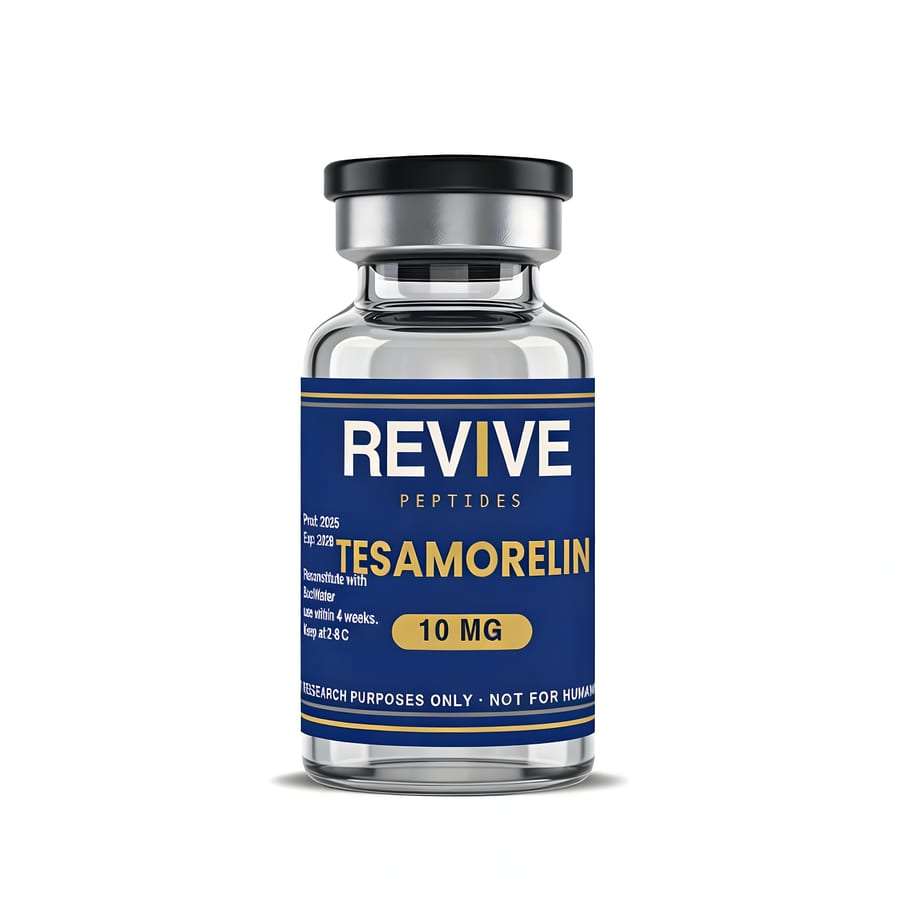
Tesamorelin 5mg & 10mg Vials — In Stock, UAE
Same-day Dubai dispatch for orders before 4 PM · 24h UAE-wide delivery · Discreet packaging · Cash on delivery Dubai
Buy Tesamorelin UAE — Same-Day Dubai Dispatch from REVIVE LAB UAEResearch Protocol Design: Where Tesamorelin Excels and Where MT-II Has Its Place
Selecting the right compound for a protocol is ultimately a question of alignment between the research question and the compound's mechanistic action. A well-designed protocol starts with the question, not the compound. The compound selection follows from that.
Tesamorelin Is the Right Selection When Your Research Question Involves:
- Growth hormone axis modulation and pulsatile GH secretion dynamics
- IGF-1 pathway downstream signalling and receptor sensitivity
- Visceral adipose tissue biology and metabolic substrate oxidation
- GH-mediated lipolytic pathway investigation in adipocyte models
- Longitudinal body composition parameter research with strong baseline comparators
- Protocol designs that require a published, peer-reviewed evidence basis for compound rationale
Melanotan II Is the Right Selection When Your Research Question Involves:
- Melanocortin receptor pharmacology and receptor subtype characterisation
- Melanogenesis pathway modelling in melanocyte cell lines
- MC4R-mediated hypothalamic signalling research
- Pan-melanocortin agonism aggregate effect studies
- Early-phase mechanistic frontier research where published clinical data is not a prerequisite
The overlap region between these two selection scenarios is small — which is the point. Research teams that arrive thinking these compounds are interchangeable are usually operating from an incomplete understanding of the receptor pharmacology. Once the mechanisms are clear, the protocol selection becomes straightforward.
Tesamorelin Research Protocol Notes for UAE Lab Settings
REVIVE LAB UAE supplies tesamorelin in 5mg and 10mg lyophilised vials — the two formats that cover the research dosing range referenced across the published literature (broadly 1–2mg per administration in research-context protocols). Lyophilised format is the appropriate specification for research use: it provides ambient-temperature storage stability until reconstitution, extended shelf life, and precision in reconstitution volume for dose preparation under controlled lab conditions.
Handling Considerations Specific to the UAE Climate
UAE research facilities face a storage and transit environment that is meaningfully more thermally challenging than most peptide research literature assumes. Receiving a lyophilised peptide vial at DXB cargo in mid-summer without proper cold-chain documentation is a different proposition to receiving the same vial in a climate-controlled European warehouse. REVIVE LAB UAE ships tesamorelin with appropriate cold-chain packaging for UAE conditions, and post-receipt storage should be maintained at 2–8°C until reconstitution.
Reconstitution should be performed with bacteriostatic water under aseptic technique in a laminar flow environment or biosafety cabinet, as per standard research peptide handling. Research teams should document reconstitution calculations — volume of bacteriostatic water added per vial and resulting concentration per unit volume — as this underpins experimental reproducibility and is essential for any multi-lab or multi-cycle protocol. The 5mg vial format suits smaller-cohort pilot studies or single-variable assays; the 10mg vial provides better per-milligram economy for extended or multi-arm protocols.
IGF-1 as a Research Biomarker in GHRH Analog Protocols
Research designs using tesamorelin as a GHRH analog should incorporate baseline and interval IGF-1 assay measurements as a standard data capture point. This is mechanistic validation practice, not a clinical monitoring requirement — IGF-1 levels provide researchers with a quantifiable downstream signal confirming that GHRH receptor stimulation is producing expected somatotropic axis responses in the study model. Without this layer, the mechanistic interpretation of outcome data is incomplete and less publishable. Labs in Abu Dhabi and Sharjah operating near university facilities with ELISA infrastructure should factor this into their protocol design from the outset.
Head-to-Head: Protocol Selection by Research Objective
| Research Objective | Recommended Compound | Rationale |
|---|---|---|
| GH axis modulation studies | Tesamorelin | GHRH-R agonism preserves physiological GH pulse architecture |
| Visceral adipose tissue biology | Tesamorelin | Stanley et al. JAMA 2014 provides VAT-specific mechanistic baseline |
| IGF-1 pathway signalling research | Tesamorelin | Downstream IGF-1 elevation is a documented, measurable output |
| Metabolic substrate oxidation | Tesamorelin | GH-driven lipolytic pathway is mechanistically relevant |
| Longitudinal protocol requiring published comparators | Tesamorelin | Falutz 2007/2010 and Stanley 2014/2019 provide baseline for comparison |
| Melanocortin receptor pharmacology | Melanotan II | Direct MC1R–MC5R agonism; no GHRH-axis involvement |
| Pigmentation pathway modelling | Melanotan II | MC1R-driven melanogenesis is the primary mechanistic pathway |
| Hypothalamic MC4R research | Melanotan II | Non-selective melanocortin agonism reaches MC4R; design for controls |
Sourcing Integrity for UAE Research: Why Supplier Selection Is a Scientific Decision
For research teams operating out of labs in Business Bay, the Palm Jumeirah medical cluster, Dubai Marina, JBR, or university facilities in Sharjah and Abu Dhabi — peptide sourcing integrity is not a secondary procurement consideration. It is a fundamental determinant of data validity and experimental reproducibility.
A tesamorelin vial compromised by inadequate cold-chain management during UAE customs transit, or containing a peptide with lower-than-labelled purity, will produce data that cannot be meaningfully compared against Falutz et al. or Stanley et al. — the very publications your protocol's mechanistic rationale cites. Research teams that cite peer-reviewed literature in their background sections but source compounds from unverified suppliers are introducing an epistemically hollow gap between their stated methodology and their actual experimental inputs. That gap does not survive peer review.
REVIVE LAB UAE addresses sourcing integrity through a supply chain built specifically for UAE research procurement requirements. Tesamorelin 5mg and 10mg vials are stored in controlled-temperature conditions at our Dubai dispatch facility. Orders placed before 4 PM receive same-day dispatch, with 24-hour delivery covering all UAE emirates — from labs near DXB airport logistics zones to Sharjah university corridor facilities and Abu Dhabi health cluster procurement desks. Every shipment uses discreet, plain outer packaging with no product or brand identification visible externally. For Dubai-based orders, cash on delivery is available alongside standard electronic payment methods including USDT via Binance Pay with a 5% pre-pay discount.
Research institutions requiring purchase orders, institutional invoicing, or cold-chain documentation for goods receipt records should contact REVIVE LAB UAE directly via WhatsApp or the site contact form. Volume pricing for tesamorelin 10mg vials is available for extended protocols — the 10mg format offers better per-milligram economy than the 5mg for multi-cycle or multi-arm research designs.
FAQ — Tesamorelin vs Melanotan II: UAE Research Procurement
Can I order tesamorelin in the UAE with same-day delivery?
Yes. REVIVE LAB UAE stocks tesamorelin 5mg and 10mg research vials with same-day dispatch from our Dubai facility for orders placed before 4 PM. Delivery covers Dubai, Abu Dhabi, Sharjah, and all UAE emirates, with 24-hour tracked courier service to all major locations. Cash on delivery is available for Dubai-area orders. All shipments use discreet plain outer packaging with no external product or brand identification. For institutional procurement with purchase order requirements, contact the REVIVE LAB UAE team directly.
What is the difference between tesamorelin and Melanotan II in a research context?
Tesamorelin is a GHRH analog that acts selectively on pituitary somatotroph GHRH receptors to stimulate endogenous GH release through the intact physiological GH axis. It carries a strong peer-reviewed evidence portfolio including publications in the NEJM (Falutz et al. 2007, 2010), JAMA (Stanley et al. 2014), and Lancet HIV (Stanley et al. 2019) — spanning nearly fifteen years of follow-up data. Melanotan II is a synthetic cyclic heptapeptide melanocortin agonist with non-selective binding across MC1R through MC5R, primarily researched for pigmentation pathway dynamics and melanocortin receptor pharmacology. The two compounds target completely different biological systems — one the GH axis, the other the melanocortin system — and are not interchangeable in any well-designed research protocol.
Does REVIVE LAB UAE offer discreet packaging for peptide research orders?
Yes. All research peptide orders from REVIVE LAB UAE ship in plain, unmarked outer packaging with no product or brand labelling visible on external surfaces. Tesamorelin vials are cold-chain packed to UAE climate standards, ensuring peptide integrity from our Dubai dispatch facility to your lab — whether you are based at Dubai Marina, JBR, Business Bay, the Palm Jumeirah medical zone, Abu Dhabi, or Sharjah. Cold-chain documentation is available on request for institutional goods receipt procedures.
- Falutz J, Allas S, Blot K, et al. Metabolic effects of a growth hormone-releasing factor in patients with HIV. New England Journal of Medicine. 2007;357(23):2359–2370.
- Falutz J, Mamputu JC, Potvin D, et al. Effects of tesamorelin (TH9507), a growth hormone-releasing factor analogue, in HIV-infected patients with abdominal fat accumulation: a randomized placebo-controlled trial with a safety extension. New England Journal of Medicine. 2010;362(23):2195–2207.
- Stanley TL, Falutz J, Mamputu JC, et al. Effects of tesamorelin on non-alcoholic fatty liver disease in HIV: a randomised, double-blind, multicentre trial. JAMA. 2014;312(4):380–389.
- Stanley TL, Fourman LT, Zheng I, et al. Effects of tesamorelin on non-alcoholic fatty liver disease and body composition in HIV: a randomised, double-blind, placebo-controlled, multicentre trial. Lancet HIV. 2019;6(12):e821–e830.
Order Tesamorelin in the UAE — In Stock at REVIVE LAB UAE
5mg & 10mg lyophilised research vials · Same-day Dubai dispatch · 24h delivery UAE-wide · Discreet packaging · Cash on delivery Dubai · WhatsApp B2B support
Order Tesamorelin UAE — In Stock at REVIVE LAB UAE