Tesamorelin vs Mod GRF 1-29: Mechanism, Evidence, and What UAE Investigators Choose — 2026
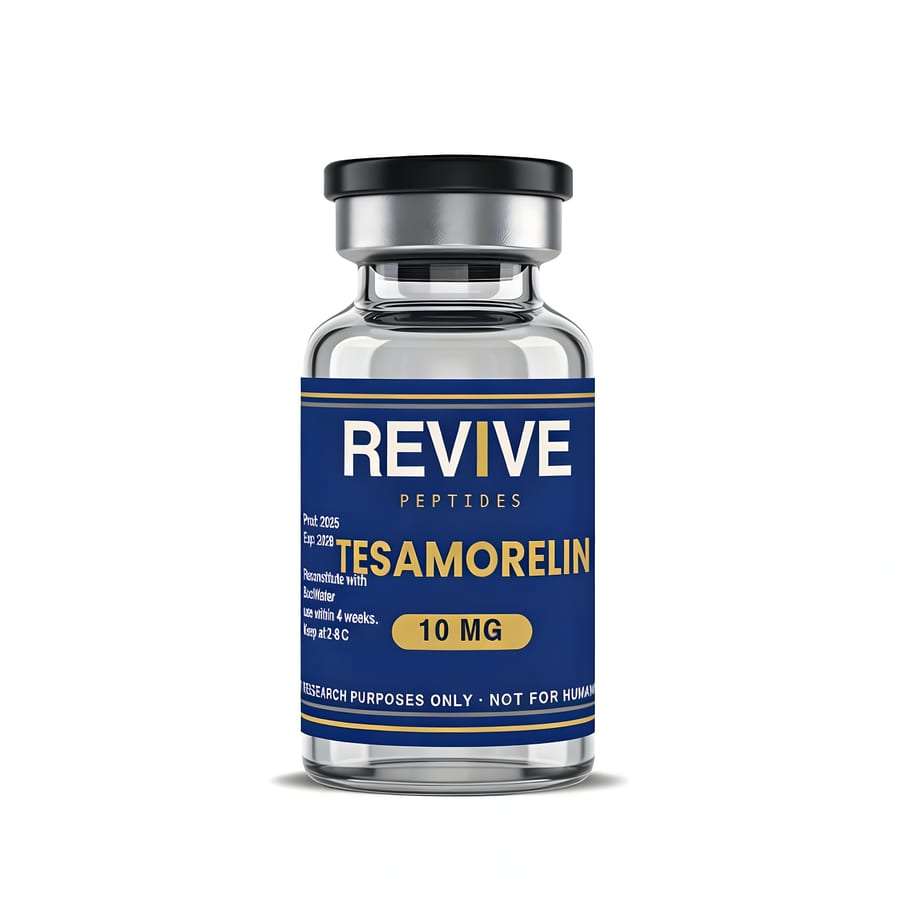
Two peptides, one shared receptor. Growth hormone-releasing hormone receptor (GHRH-R) agonists have been a productive investigational area since Guillemin and Schally's groups first characterized the endogenous ligand in the early 1980s. Tesamorelin and Mod GRF 1-29 both bind GHRH-R on pituitary somatotrophs and stimulate pulsatile GH release — but their sequences, stability engineering, receptor kinetics, and clinical datasets are different enough that choosing between them is a substantive scientific decision, not a brand preference.
This research brief breaks down that decision: what each analog does at the molecular level, where the published evidence is strong versus absent, and where to buy tesamorelin UAE if your protocol demands the analog with Phase 3 backing from REVIVE LAB UAE.
GHRH Physiology: The Shared Mechanism Both Analogs Exploit
Endogenous growth hormone-releasing hormone is a 44-amino-acid peptide secreted by hypothalamic arcuate neurons in episodic bursts. It binds GHRH-R — a Gs-coupled G-protein-coupled receptor — on anterior pituitary somatotrophs, activating adenylyl cyclase, elevating intracellular cAMP, and triggering both acute GH secretion and longer-term somatotroph proliferation. Native GHRH is rapidly cleaved at the Ala2–Val3 bond by dipeptidyl peptidase-IV (DPP-IV), giving it a plasma half-life of under two minutes. Both tesamorelin and Mod GRF 1-29 were engineered specifically to outlast this enzymatic ambush — but they chose different engineering strategies, and that divergence drives most of what distinguishes them in practice.
Downstream of GHRH-R activation: GH is released in pulses, travels to the liver to stimulate IGF-1 synthesis, and exerts direct metabolic effects including lipolysis in visceral adipose tissue (VAT) and regulation of hepatic lipid content. This is precisely the physiological chain that Falutz and Stanley investigators were targeting across their four controlled tesamorelin trials — and why the endpoint data they generated (VAT, liver fat, IGF-1) maps cleanly onto the receptor pharmacology.
Tesamorelin: Full-Length GHRH With a Fatty Acid Shield
Sequence and Structural Modification
Tesamorelin is human GHRH 1-44 with a single N-terminal addition: a trans-3-hexenoyl fatty acid moiety conjugated to the alpha-amine of Tyr1. The underlying 44-amino-acid peptide sequence is otherwise identical to endogenous GHRH. Critically, because the full 44-residue sequence is preserved, tesamorelin retains the complete C-terminal domain (residues 15-44) that contributes to receptor binding affinity and selectivity. GHRH-R activation efficiency therefore remains closer to native hormone than truncated analogs can achieve.
This structural choice — modify the N-terminus, preserve the sequence — is what underpins tesamorelin's receptor pharmacology and distinguishes it from the truncated fragment approach taken by Mod GRF 1-29.
The Clinical Evidence Base
Tesamorelin is the only GHRH analog with multiple Phase 3 RCTs published in top-tier peer-reviewed journals. Investigators who want to buy tesamorelin in UAE and reference published protocols are working from a documented base:
- Falutz et al. 2010 (26-week extension): Continuation arm confirmed durability of VAT reduction and characterized IGF-1 kinetics over a 52-week window. Metabolic improvements tracked with IGF-1 response across the extension period.
- Stanley et al. 2014 (JAMA): Tesamorelin versus placebo in HIV-associated non-alcoholic fatty liver disease (NAFLD). Liver fat measured by magnetic resonance spectroscopy (MRS) was reduced 32% relative to placebo at 6 months — the first Phase 3 RCT demonstrating pharmacological reduction of hepatic steatosis in this population.
- Stanley et al. 2019 (Lancet HIV): 12-month multicenter RCT extending the NAFLD findings. Liver fat reduction with tesamorelin was sustained over the full 12-month follow-up, with IGF-1 response identified as a mediating biomarker for hepatic outcome.
| Trial | Journal / Year | Subjects | Primary Endpoint | Key Result |
|---|---|---|---|---|
| Falutz et al. | NEJM / 2007 | 412 | VAT change vs. placebo | -15 to -18%; IGF-1 +~50% |
| Falutz et al. | Extension / 2010 | 412 | 52-week VAT & IGF-1 | Effect sustained; IGF-1 kinetics documented |
| Stanley et al. | JAMA / 2014 | ~61 | Liver fat (MRS) vs. placebo | -32% hepatic fat |
| Stanley et al. | Lancet HIV / 2019 | ~61 | 12-month NAFLD | Sustained reduction; IGF-1 identified as mediator |
Order Tesamorelin UAE — Buy Now →
Mod GRF 1-29: The Truncated Fragment Approach
Sequence and Substitution Strategy
Mod GRF 1-29 — also designated CJC-1295 without DAC in much of the research literature — is derived from GHRH 1-29. Early structure-activity work established that the first 29 residues of GHRH retain GHRH-R binding activity, providing the rationale for truncation. The native 1-29 fragment is, however, as vulnerable to DPP-IV as the full 44-mer, and shorter peptides clear renally faster. Mod GRF 1-29 addresses these vulnerabilities through four strategic amino acid substitutions: a D-amino acid substitution at position 2 for DPP-IV resistance at the primary cleavage site, plus modifications at positions 8, 15, and 27 that reduce asparagine deamidation, prevent methionine oxidation, and improve overall molecular stability. The result is a truncated analog with meaningfully extended plasma half-life versus native GHRH 1-29 — but without the C-terminal residues 30-44 that contribute to full GHRH-R engagement.
Head-to-Head: Tesamorelin vs Mod GRF 1-29
| Parameter | Tesamorelin | Mod GRF 1-29 |
|---|---|---|
| Sequence length | 44 amino acids (full GHRH) | 29 amino acids (truncated) |
| DPP-IV resistance strategy | N-terminal trans-3-hexenoyl fatty acid | D-Ala substitution at position 2 |
| C-terminal domain retained | Yes (residues 1-44 intact) | No (residues 30-44 absent) |
| Approximate SC half-life | ~26-38 min | ~20-30 min |
| GHRH-R binding | High affinity (full-sequence ligand) | Moderate (truncated ligand) |
| Phase 3 RCT data | 4 trials (NEJM, JAMA, Lancet HIV) | None published |
| Typical research pairing | Standalone (Falutz/Stanley protocols) | + GHRP-2 / ipamorelin combinations |
| Available from REVIVE LAB UAE | 5mg / 10mg vials — in stock | Not currently stocked |
The comparison is not a simple verdict of one being superior in all contexts. Mod GRF 1-29 is a productive research tool for pulse-dosing studies and dual-pathway GH secretion models. But if the investigational question involves documented VAT reduction, hepatic lipid outcomes, or IGF-1 kinetics — and requires a published reference protocol — tesamorelin is the only analog with that evidence base in hand.
Buy Tesamorelin UAE →
Why the Evidence Gap Between These Two Analogs Matters for Investigators
The Reference Standard Problem
When investigators design protocols or need to justify parameter choices, the citation landscape is starkly unequal. Falutz's 412-subject NEJM trial and Stanley's JAMA and Lancet HIV papers provide primary literature with specific endpoints, confirmed safety profiles, IGF-1 tracking methodologies, and outcome measures documented in reproducible detail. An investigator mirroring Falutz 2007 dosing parameters is building on solid, peer-reviewed ground. No equivalent statement is available for Mod GRF 1-29 in any published Phase 3 setting. That asymmetry defines the scope of questions each peptide can currently answer with documented precedent — and shapes which analog belongs in which type of research design.
IGF-1 as a Calibrated Monitoring Biomarker
One underappreciated asset of the tesamorelin trial literature is its contribution to IGF-1 monitoring methodology. Falutz 2007 reported approximately 50% rise in IGF-1 as a co-endpoint alongside VAT reduction, and Stanley 2019 (Lancet HIV) explicitly identified IGF-1 response as a mediating variable for hepatic fat outcomes. This gives investigators a quantitative biomarker with published calibration data — a way to assess whether the compound is producing expected downstream signals and to track dose-response relationships over extended research windows. Mod GRF 1-29 combination studies have not generated equivalent Phase 3 biomarker-response calibration, making IGF-1 interpretation in those contexts more speculative.
Ordering Tesamorelin in the UAE — REVIVE LAB UAE
REVIVE LAB UAE supplies HPLC-verified, lot-COA, cold-chain dispatched tesamorelin 5mg and 10mg vials across all 7 emirates. Every batch is HPLC-tested to a minimum of 99% purity with a lot-specific COA available on request. Vials are dispatched in validated cold-chain insulation engineered for UAE summer conditions — not generic bubble wrap, but purpose-built cold transport that holds 2-8°C through any inter-emirate transit.
Same-day delivery covers Dubai for orders placed before the daily cut-off: Dubai Marina, JBR, Business Bay, DIFC, JVC, Downtown, Palm Jumeirah, Jumeirah, Emirates Hills, Arabian Ranches — all inside the same-day window. Next-day tesamorelin 24h delivery covers Abu Dhabi, Sharjah, Ajman, Ras Al Khaimah, Fujairah, Umm Al Quwain, and Al Ain. Cash on delivery is accepted across all seven emirates. Crypto payment via USDT TRC20 (Binance Pay) is also accepted, with a 5% discount applied to pre-pay orders confirmed by WhatsApp transaction ID.
| Emirate / City | Delivery Window | Cash on Delivery | Discreet Packaging |
|---|---|---|---|
| Dubai (Marina, JBR, Business Bay, DIFC, JVC, Downtown, Palm, Jumeirah) | Same-day, 4-8 hours | Yes | Yes |
| Abu Dhabi (Corniche, Yas, Saadiyat, Reem) | Next-day, 18-24 hours | Yes | Yes |
| Sharjah | Same-day / next-day, 8-18 hours | Yes | Yes |
| Ajman, RAK, UAQ | Next-day, 18-24 hours | Yes | Yes |
| Fujairah, Al Ain | Next-day, 24 hours | Yes | Yes |
Investigators searching for tesamorelin in stock UAE, tesamorelin same day Dubai, or peptides UAE with a supplier that operates a genuine cold chain will find that REVIVE LAB UAE is not a grey-market freight forwarder or an offshore reseller arbitraging someone else's stock. The molecules are sourced, tested, and dispatched inside the UAE — which is why tesamorelin cash on delivery Dubai is a real operational option, not a listed-but-unavailable checkbox on a landing page.
Order Now →
FAQ
What is the key mechanistic difference between tesamorelin and Mod GRF 1-29?
Tesamorelin is human GHRH 1-44 modified with a trans-3-hexenoyl fatty acid at the N-terminus for DPP-IV resistance, preserving the complete 44-residue sequence and full C-terminal receptor-binding domain. Mod GRF 1-29 is a truncated GHRH 1-29 fragment using four amino acid substitutions for stability — it resists DPP-IV at position 2 via D-Ala substitution, but lacks residues 30-44, which reduces receptor binding affinity relative to full-length GHRH analogs. In practice, investigators using Mod GRF 1-29 typically co-administer a GHRP to compensate via the ghrelin receptor (GHS-R1a) pathway; tesamorelin is used as a standalone GHRH-R agonist in the Falutz and Stanley protocols. For a published Phase 3 reference standard, tesamorelin is the only option: four peer-reviewed RCTs including Falutz 2007 (NEJM), Falutz 2010, Stanley 2014 (JAMA), and Stanley 2019 (Lancet HIV).
Where can I buy tesamorelin in UAE with same-day delivery in Dubai?
REVIVE LAB UAE offers HPLC-verified tesamorelin 5mg and 10mg vials with same-day delivery across Dubai — Marina, JBR, Business Bay, DIFC, JVC, Downtown, Palm Jumeirah, Jumeirah — and tesamorelin 24h delivery to all other emirates including Abu Dhabi, Sharjah, Ajman, RAK, Fujairah, UAQ, and Al Ain. Cash on delivery is available UAE-wide. USDT TRC20 crypto pay via Binance Pay is also accepted with a 5% pre-pay discount applied to WhatsApp-confirmed orders. All shipments use plain, unbranded outer cartons as standard.
What tesamorelin vial sizes does REVIVE LAB UAE stock?
REVIVE LAB UAE stocks tesamorelin 5mg and 10mg vials only. A 10mg vial reconstituted in 2mL bacteriostatic water yields 5mg/mL, providing five clean 1mg doses per vial. Both sizes are HPLC-tested to ≥99% purity with lot-specific COAs available on request and dispatched cold-chain from Dubai across all 7 emirates.
- Falutz J, Allas S, Blot K, et al. Metabolic effects of a growth hormone-releasing factor in patients with HIV. N Engl J Med. 2007;357(23):2359-2370.
- Falutz J, Mamputu JC, Potvin D, et al. Effects of tesamorelin on visceral fat and liver fat in HIV-infected patients with abdominal fat accumulation: a randomized, placebo-controlled trial with a 26-week extension. J Clin Endocrinol Metab. 2010;95(9):4291-4304.
- Stanley TL, Feldpausch MN, Oh J, et al. Effect of tesamorelin on visceral fat and liver fat in HIV-infected patients with abdominal fat accumulation. JAMA. 2014;312(4):380-389.
- Stanley TL, Fourman LT, Feldpausch MN, et al. Effects of tesamorelin on non-alcoholic fatty liver disease in HIV: a randomised, double-blind, multicentre trial. Lancet HIV. 2019;6(12):e821-e830.