Tesamorelin vs Sermorelin vs CJC-1295: GHRH Research Peptide Comparison
Three peptides dominate the GHRH (growth hormone-releasing hormone) research space — Tesamorelin, Sermorelin, and CJC-1295. They are all GHRH-receptor agonists, but they differ on one critical axis: how long they stay active. That single property — half-life — reshapes everything from the pulsatility of downstream GH release to which research protocol they fit.
The single-line answer
Sermorelin is the native GHRH 1-29 fragment — short, pulsatile, the closest analogue to physiological GHRH. Tesamorelin is a stabilised 44-amino-acid full GHRH analogue with the strongest clinical trial program of the three. CJC-1295 with DAC is a long-acting modification engineered for ~6-8 day half-life via albumin binding.
| Compound | Structure | Half-life | Clinical Stage |
|---|---|---|---|
| Sermorelin | GHRH 1-29 fragment (29 aa) | ~10-20 min | FDA-approved (Geref, discontinued) |
| Tesamorelin | Modified 44-aa GHRH (trans-3-hexenoyl) | ~26 min | FDA-approved (Egrifta, 2010) |
| CJC-1295 (DAC) | GHRH 1-29 + DAC (albumin-binding) | ~6-8 days | Phase 1/2 only — not approved |
Why half-life matters more than potency
Native GHRH has a plasma half-life of about 7 minutes. That short window is biologically purposeful: the pituitary releases growth hormone in pulses, primarily during slow-wave sleep, and the brief lifetime of endogenous GHRH is what keeps that pulsatility intact. Any GHRH analogue has to make a trade-off between preserving that pulsatile pattern and being practical to dose.
Each of the three peptides made a different call:
- Sermorelin keeps the trade-off closest to native GHRH — very short half-life, fully pulsatile, but requires daily (or twice-daily) administration in research protocols.
- Tesamorelin takes the middle road — its modified structure extends half-life to ~26 minutes while preserving the pulsatile GH response. Once-daily dosing.
- CJC-1295 DAC goes to the opposite extreme — multi-day exposure via albumin binding. Convenient dosing, but it produces a near-continuous GH-axis activation (sometimes called "GH bleed") rather than discrete pulses.
Worth noting: there are two CJC-1295 variants in circulation — CJC-1295 DAC (with the albumin-binding Drug Affinity Complex, ~6-8 day half-life) and CJC-1295 No-DAC (also called Modified GRF 1-29, half-life ~30 minutes). They behave more like Sermorelin/Tesamorelin than like the long-acting DAC version. Always check which variant a paper or product refers to.
Clinical trial data
This is where the three diverge sharply. Trial data only exists for the two with completed clinical programs:
| Compound | Phase 3 Trials | Key Endpoint Achieved | Regulatory Status |
|---|---|---|---|
| Sermorelin | FDA approval 1990s (paediatric GH deficiency) | Stimulated GH release, increased growth velocity | Approved as Geref — discontinued commercially |
| Tesamorelin | Falutz 2010, Stanley 2014 — both NEJM/JAMA-level Phase 3 | −15.2% VAT (visceral adipose tissue) at 26 weeks | Approved as Egrifta (2010) for HIV lipodystrophy |
| CJC-1295 | Phase 1 PK study (Teichman 2006); no Phase 3 | Sustained IGF-1 elevation at single dose | Not approved — Phase 2 program halted |
Tesamorelin's clinical record is the most relevant for research models: two large Phase 3 RCTs showing reproducible reductions in visceral adipose tissue, normalised triglycerides, and reduced liver fat — all in humans, all peer-reviewed at NEJM/JAMA level. This is why Tesamorelin is the GHRH analogue most often cited as a reference compound in current metabolic and body-composition research.
How the three differ in research use
Sermorelin — closest to physiological pattern
For research protocols where you want to mimic native GHRH-like pulsatility — circadian GH-axis studies, sleep-pulse research, paediatric GH-deficiency models — Sermorelin is the most appropriate choice. It is also the most "fragile" GHRH analogue, requiring careful handling and frequent dosing.
Tesamorelin — strongest body-composition research record
For research on visceral adipose tissue, hepatic fat (NAFLD/NASH models), and the metabolic effects of pulsatile GH stimulation, Tesamorelin is the reference compound. Its 44-amino-acid structure is also closer to native GHRH than the 29-amino-acid Sermorelin/CJC backbones, which matters for full-length GHRH receptor binding studies.
CJC-1295 DAC — convenience over physiology
CJC-1295 DAC has the most practical dosing schedule (once-weekly research dose), and it produces the most sustained IGF-1 elevation. The trade-off is that the constant GHRH-receptor stimulation departs from natural physiology — for research questions where pulsatility itself is the variable being studied, this is a problem rather than a feature.
The Ipamorelin / GHRP angle
In a meaningful percentage of research protocols, GHRH analogues are combined with GHS-R1a agonists (ghrelin mimetics like Ipamorelin, GHRP-2, GHRP-6, Hexarelin). The two receptors are independent and the GH-release effects are synergistic — combined administration produces a larger GH peak than either alone. The most commonly studied pairings are:
- Sermorelin + Ipamorelin — short pulsatile pairing, popular in age-related GH research
- CJC-1295 + Ipamorelin — long-acting pairing with the most public research data, often described as the "GH pulse stack"
- Tesamorelin + Ipamorelin — less commonly studied but mechanistically clean given Tesamorelin's pulsatile pattern
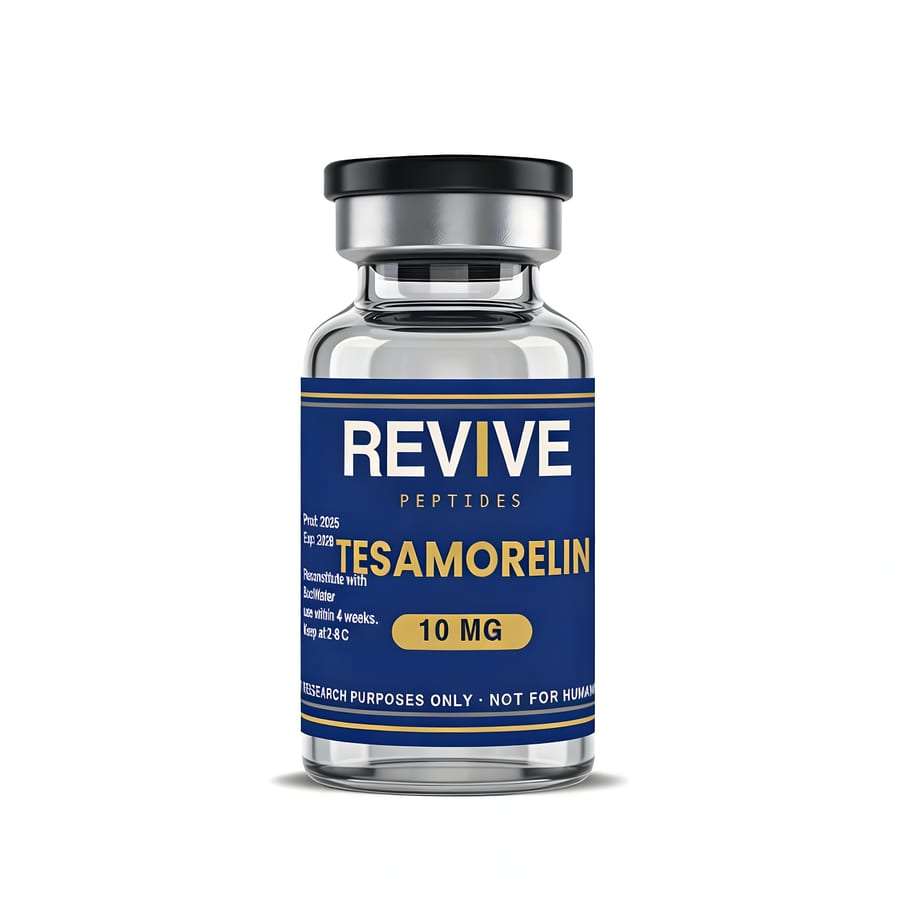
Need research-grade Tesamorelin in the UAE?
HPLC ≥ 98.5% purity · Lot-specific COA · 24h cold-chain delivery · 10 mg flagship vials
View Tesamorelin product pagePractical research notes — handling and reconstitution
Stability
All three are lyophilized powders supplied frozen or refrigerated. Tesamorelin is the most stability-sensitive of the three (the modified N-terminus is more prone to degradation than the simpler GHRH 1-29 backbone). Sermorelin and CJC-1295 are relatively forgiving. Once reconstituted, all three require refrigeration at 2-8°C and should be used within ~28 days.
Reconstitution volume
For a 10 mg Tesamorelin vial, 3-5 mL of bacteriostatic water is the standard reconstitution volume. For Sermorelin and CJC-1295, 2-3 mL is typical for 5 mg vials. Always swirl — do not vortex or shake (peptide chains can shear).
Storage post-reconstitution
2-8°C, protected from light, used within 28 days. The benzyl alcohol in bacteriostatic water preserves the solution for multi-dose research over that window. Plain sterile water has no preservative and must be used single-dose.
Where each fits in a 2026 research portfolio
- If your research question is about pulsatile physiology: Sermorelin. Its short half-life is the feature, not a bug.
- If your research question is about body composition / VAT / hepatic fat: Tesamorelin. The clinical record is decisive.
- If your research question is about sustained GHRH-receptor activation: CJC-1295 DAC. The unique long-acting profile fills a niche the other two cannot.
Companion peptides commonly stacked with GHRH analogues
Beyond the Ipamorelin pairing already mentioned, two peptides are frequently co-administered in our customer research protocols:
- Retatrutide — incretin triple agonist; combined body-composition research (incretin-driven weight loss + GH-axis stimulation).
- GHK-Cu — copper tripeptide for dermal-collagen research alongside the IGF-1 effects of the GH axis.
Frequently asked questions
Is Tesamorelin the same as Sermorelin?
No. Both are GHRH analogues but with different structures and pharmacology. Sermorelin is the native GHRH 1-29 fragment (29 amino acids). Tesamorelin is a stabilised 44-amino-acid analogue with an N-terminal modification that extends half-life ~3-fold compared to native GHRH.
Why was CJC-1295 never approved?
Phase 1 PK data were promising, but Phase 2 development was halted following safety signals during early human trials in the mid-2000s. It remains a research-only compound. CJC-1295 reference material is supplied for laboratory and research use, not for human or veterinary administration.
Which GHRH peptide is commonly used for fat loss research?
On the published evidence, Tesamorelin — two Phase 3 RCTs documented reductions in visceral adipose tissue, hepatic fat, and triglycerides at 26-week endpoints. The Falutz 2010 and Stanley 2014 trials are the foundation papers; both are open-access at JCEM and JAMA respectively.
Can these peptides be used for human treatment?
Tesamorelin is FDA-approved as Egrifta for the specific indication of HIV-associated lipodystrophy under prescription. It is not approved for general use. Sermorelin's commercial approval has been discontinued. CJC-1295 has never been approved. Reference material supplied by REVIVE LAB UAE is sold strictly for laboratory research use, not for human or veterinary administration.
References
- Falutz J et al. Effects of Tesamorelin (TH9507), a Growth Hormone-Releasing Factor Analog, in HIV-Infected Patients With Excess Abdominal Fat: A Pooled Analysis of Two Multicenter, Double-Blind Placebo-Controlled Phase 3 Trials. J Clin Endocrinol Metab. 2010;95(9):4291-4304.
- Stanley TL et al. Effect of Tesamorelin on Visceral Fat and Liver Fat in HIV-Infected Patients With Abdominal Fat Accumulation: A Randomized Clinical Trial. JAMA. 2014;312(4):380-389.
- Teichman SL et al. Prolonged stimulation of growth hormone (GH) and insulin-like growth factor I secretion by CJC-1295, a long-acting analog of GH-releasing hormone, in healthy adults. J Clin Endocrinol Metab. 2006;91(3):799-805.
- Walker RF. Sermorelin: a better approach to management of adult-onset growth hormone insufficiency? Clin Interv Aging. 2006;1(4):307-308.
- Sigalos JT, Pastuszak AW. The Safety and Efficacy of Growth Hormone Secretagogues. Sex Med Rev. 2018;6(1):45-53.