Tesamorelin in Women: Sex-Specific Research Protocols for UAE (2026)
Why Women Were Under-Studied in the Tesamorelin Trials
Tesamorelin reached the FDA in 2010 on the back of two pivotal Phase III trials run by Falutz and colleagues (NEJM 2007; JAIDS 2010). Both were conducted in HIV-positive adults with central lipodystrophy — a population that, in North America in the mid-2000s, skewed roughly 85% male. The pooled enrolment of ~800 subjects included only ~120 women, and the trials were powered for the combined population, not for sex-specific endpoints.
The result: tesamorelin's label-driving evidence is overwhelmingly male. Women were included, the drug worked in them, but the dose-response curve, IGF-1 kinetics, and side-effect profile in female subjects were not the primary focus of any pivotal trial. This created a long-standing gap that Stanley 2014 (JCEM) was the first to address with a formal sex subgroup analysis.
Stanley 2014 — The Sex Subgroup Analysis That Matters
Steven Grinspoon's group at Massachusetts General Hospital pooled the two Falutz Phase III datasets and performed a pre-specified sex subgroup analysis (Stanley TL et al., J Clin Endocrinol Metab 2014). Key findings:
| Endpoint | Men (n≈680) | Women (n≈120) |
|---|---|---|
| VAT reduction at 26 weeks | −15.7% | −13.9% |
| Time to peak VAT response | ~20 weeks | ~26 weeks |
| IGF-1 increase (% from baseline) | +81% | +47% |
| Triglyceride reduction | −50 mg/dL | −38 mg/dL |
| Discontinuation for AE | 9.2% | 11.4% |
Women generated roughly 58% of the IGF-1 elevation men did from the same dose — likely reflecting baseline differences in growth hormone binding protein, oestrogen-modulated hepatic IGF-1 production, and somatostatinergic tone.
What This Means For Research Protocols
- Track VAT, not IGF-1, as the primary endpoint. IGF-1 in women on tesamorelin will underestimate the GH-axis effect.
- Extend study duration to 26+ weeks. The 20-week early-readout windows used in male-dominant trials will under-capture the female response curve.
- Pre-menopausal vs post-menopausal stratification matters. Oestrogen modulates hepatic IGF-1 production directly; pooling pre- and post-menopausal women obscures the signal.
Menstrual Cycle Effects on the GH-IGF-1 Axis
Endogenous growth hormone pulsatility is not constant across the menstrual cycle. Faria et al. (J Clin Endocrinol Metab 1992) and subsequent work showed:
- Late follicular phase (days 10–14): peak GH pulse amplitude, driven by rising oestradiol
- Mid-luteal phase (days 20–24): moderate amplitude, progesterone-stabilised
- Early follicular phase (days 1–5): lowest amplitude, low sex steroids
Tesamorelin (a GHRH analogue) acts by amplifying endogenous GH pulses, so the same 2 mg dose theoretically produces a larger absolute GH response in the late follicular window than in early follicular. In practice, this variability is averaged out across multi-week dosing, but it has two implications for research:
- IGF-1 sampling timing matters. Always sample at the same cycle phase across visits, or normalise to cycle day.
- Single-dose pharmacodynamic studies should specify cycle phase. Otherwise you confound the drug effect with endogenous cycle variance.
For chronic dosing (the standard 26-week VAT protocol), no cycle-phase adjustment is needed. The drug is dosed daily, the IGF-1 axis reaches a new steady state within 2–3 weeks, and cycle-driven oscillations become noise rather than signal.
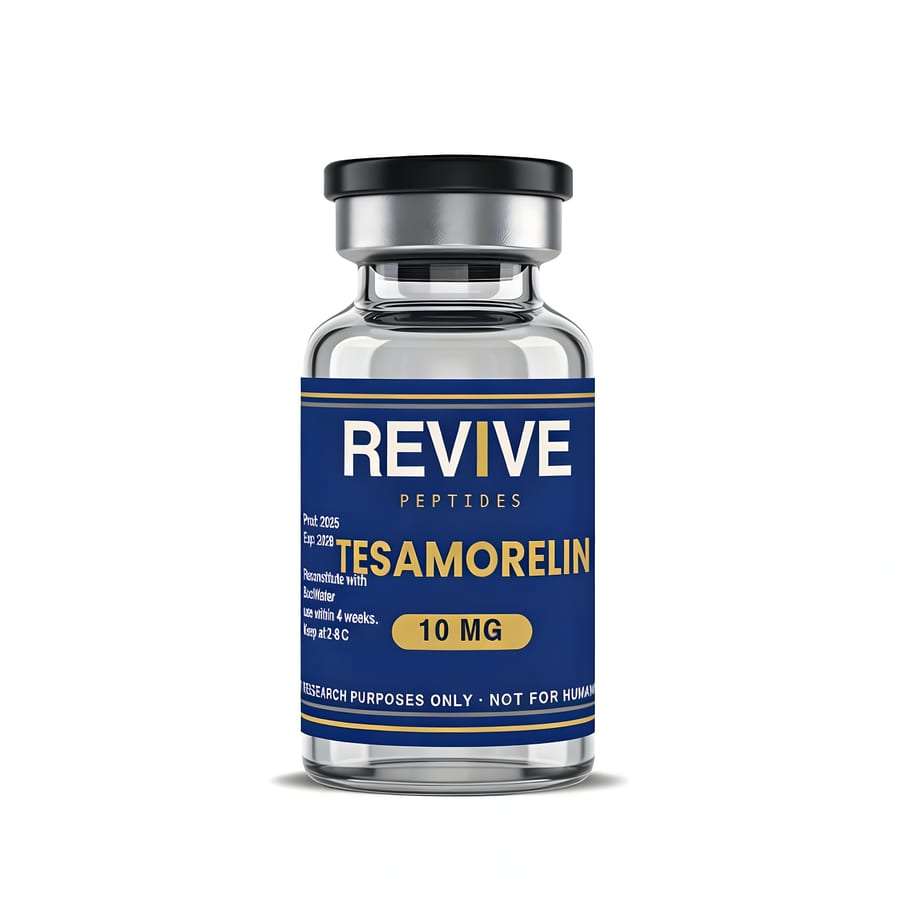
REVIVE LAB ships tesamorelin 5 mg and 10 mg vials from Dubai stock with HPLC certificate of analysis, cold-chain packaging, and 24h delivery across all seven emirates. Same-day delivery within Dubai for orders before 4 PM.
Buy Tesamorelin UAE — 24h Delivery →
The Falutz HIV Trials — What Women Actually Got
Looking back at the foundational evidence with a female-specific lens:
Falutz 2007 (NEJM) enrolled 412 subjects, of whom 59 were women. At week 26, women in the tesamorelin arm achieved a 15.0% VAT reduction vs +5.0% in placebo — a treatment effect of ~20 percentage points, slightly larger than the male treatment effect. The catch: IGF-1 rose only ~40% in women vs ~85% in men.
Falutz 2010 (JAIDS) was the 6-month extension trial, enrolling 404 subjects, of whom ~80 were women. VAT reduction was maintained at week 52 in continuing-treatment subjects of both sexes. Notably, women who switched from placebo to tesamorelin at week 26 caught up to the originally-treated group within 12 weeks — confirming the drug works on the female VAT depot identically, just with different IGF-1 amplitude.
Result: 14% VAT reduction vs placebo, comparable to the HIV trial effect, with IGF-1 elevation again blunted relative to historical male data. This was the first dedicated female-only tesamorelin trial and confirmed the drug works outside the HIV context.
Side-Effect Profile in Women
The Stanley 2014 sex subgroup found a slightly higher discontinuation rate in women (11.4% vs 9.2% in men). The driver was not new side effects but exaggeration of common ones:
- Injection-site reactions: more frequently reported by female subjects (likely a reporting-rate artefact rather than biological)
- Arthralgia / fluid retention: appeared at similar absolute frequency but was rated more bothersome on quality-of-life instruments
- Paraesthesia: minor numerical excess in women, no statistical difference
- Hyperglycaemia: identical in both sexes — tesamorelin's mild glucose effect is sex-independent
For a deeper look at side-effect mitigation across all populations, see our tesamorelin side-effects mitigation guide.
Where to Buy Tesamorelin in the UAE — REVIVE LAB Stock & 24h Delivery
REVIVE LAB holds tesamorelin in Dubai stock and is the fastest source in the UAE for research-grade material. We supply tesamorelin in two vial sizes:
| Tesamorelin 5 mg | ~2.5 days | 24h to all emirates, same-day Dubai |
| Tesamorelin 10 mg | ~5 days | 24h to all emirates, same-day Dubai |
24h Delivery Coverage
- Dubai: same-day if ordered before 4 PM, otherwise next-day
- Abu Dhabi: 24h delivery, dispatched from Dubai stock
- Sharjah: 24h delivery, often same-day for early orders
- Ajman, RAK, UAQ, Fujairah: 24h to next-day, cold-chain maintained
Cold-Chain Logistics
Tesamorelin lyophilised powder is stable at room temperature short-term, but REVIVE ships every vial in insulated packaging with gel packs to preserve potency through UAE summer temperatures. Once reconstituted, the vial requires refrigeration (2–8°C) and remains stable for 14 days — see our UAE peptide fridge storage guide.
Ordering Process
- Place order via tesamorelin UAE product page
- Receive HPLC certificate of analysis by email within 1 hour
- Cold-chain courier dispatch from Dubai warehouse (same-day cut-off 2 PM)
- Delivery within 24 hours to any UAE emirate
- Reconstitution support via WhatsApp on request
For the broader product range and additional peptides, browse the full REVIVE peptides UAE catalogue.
Practical Female-Specific Protocol Template
For researchers designing a female-cohort tesamorelin study, the Stanley 2014 data supports this template:
- Duration: minimum 26 weeks for VAT endpoint, 52 weeks preferred
- Stratification: pre-menopausal vs post-menopausal at enrolment
- Primary endpoint: VAT change by CT or MRI at week 26 and 52
- Secondary endpoints: IGF-1 (sampled mid-luteal, weeks 4, 12, 26), triglycerides, HbA1c, quality of life
- Cycle-phase IGF-1 sampling: for pre-menopausal women, standardise to mid-luteal phase across visits
- Safety monitoring: fasting glucose at baseline, week 12, week 26; injection-site review every visit
References
- Falutz J, Allas S, Blot K, et al. Metabolic effects of a growth hormone-releasing factor in patients with HIV. N Engl J Med. 2007;357(23):2359–2370.
- Falutz J, Mamputu JC, Potvin D, et al. Effects of tesamorelin (TH9507), a growth hormone-releasing factor analog, in human immunodeficiency virus-infected patients with excess abdominal fat: a pooled analysis of two multicenter, double-blind placebo-controlled phase 3 trials with safety extension data. J Clin Endocrinol Metab. 2010;95(9):4291–4304.
- Stanley TL, Falutz J, Marsolais C, et al. Reduction in visceral adiposity is associated with an improved metabolic profile in HIV-infected patients receiving tesamorelin. Clin Infect Dis. 2012;54(11):1642–1651.
- Stanley TL, Feldpausch MN, Oh J, et al. Effect of tesamorelin on visceral fat and liver fat in HIV-infected patients with abdominal fat accumulation: a randomized clinical trial. JAMA. 2014;312(4):380–389.
- Stanley TL, Chen CY, Branch KL, Makimura H, Grinspoon SK. Effects of a growth hormone-releasing hormone analog on endogenous GH pulsatility and insulin sensitivity in healthy men. J Clin Endocrinol Metab. 2011;96(1):150–158.
- Faria AC, Bekenstein LW, Booth RA Jr, et al. Pulsatile growth hormone release in normal women during the menstrual cycle. Clin Endocrinol (Oxf). 1992;36(6):591–596.
- Mulder H, Falutz J, Cherry CL, et al. Long-term safety and efficacy of tesamorelin in HIV-infected patients with abdominal fat accumulation: a 52-week extension study. AIDS. 2011;25(13):1601–1609.