GLP-1 Muscle Loss and Tesamorelin Co-Administration — The Research
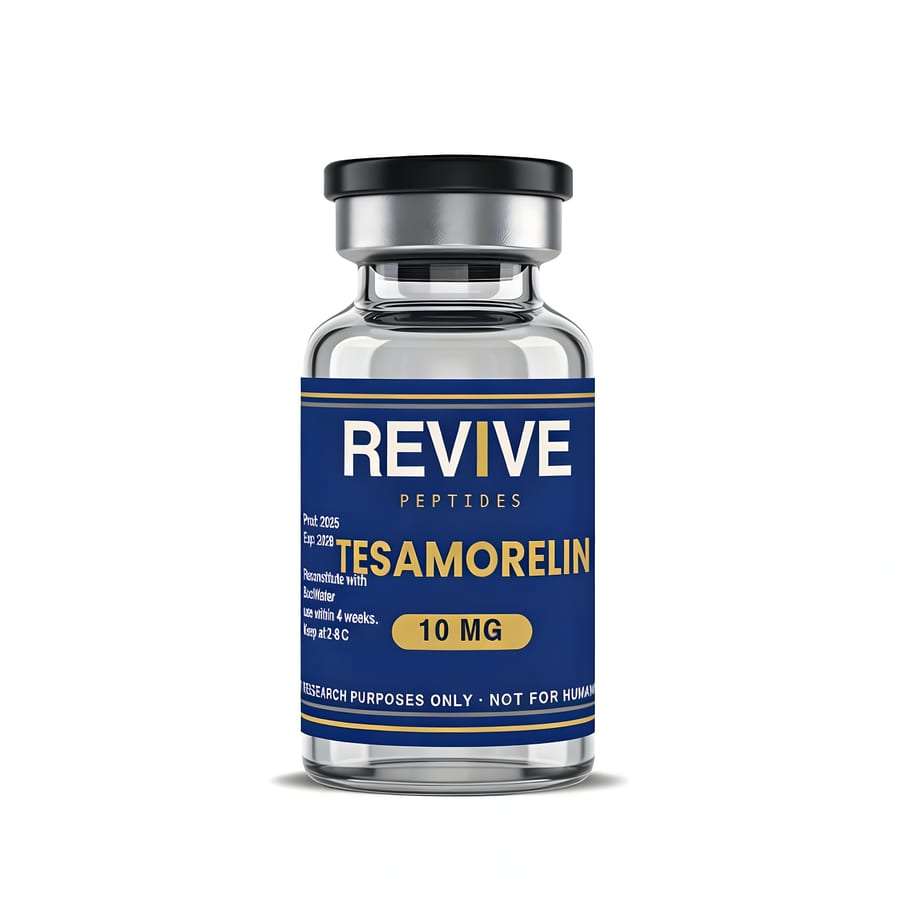
The GLP-1 lean-mass problem is one of the most-discussed and least-acknowledged findings in the obesity-research literature: roughly a quarter to two-fifths of weight reduction on semaglutide, tirzepatide, or retatrutide monotherapy comes from lean tissue, not fat. The published peptide-stack response is to co-administer a GHRH analogue — almost always Tesamorelin — to drive endogenous GH pulse and preserve muscle protein synthesis. This is the research breakdown.
1. The body-composition data from GLP-1 trials
The headline weight-loss numbers from major GLP-1 / GIP / triple-agonist trials are well known. The body-composition substudies that look at fat-mass vs lean-mass split are less frequently cited but are where the muscle-loss question sits.
| Trial / agent | Weight loss | Lean mass loss | Lean as % of total |
|---|---|---|---|
| STEP-1 (semaglutide 2.4 mg) | ~14.9% | ~10.4 kg in DEXA substudy | ~39% of total loss was lean |
| SURMOUNT-1 (tirzepatide 15 mg) | ~22.5% | ~10.9 kg DEXA | ~25-30% of total loss was lean |
| Retatrutide phase 2 (Jastreboff 2023, 12 mg) | ~24.2% | Not yet fully published; preliminary suggests similar range | Expected ~25-35% |
The ratio is roughly stable across compound classes because the underlying mechanism is shared: caloric restriction without resistance-stimulus + insufficient protein intake invariably produces some lean-mass loss. GLP-1 agonists drive caloric restriction primarily through appetite suppression and delayed gastric emptying; they don't actively protect muscle.
2. Why this matters more than the topline weight number
Lean body mass is the dominant determinant of resting metabolic rate. Losing 5-8 kg of lean tissue reduces resting energy expenditure by ~150-250 kcal/day. That metabolic adaptation is a major reason for the GLP-1 weight regain seen after discontinuation — the body's energy demand is now permanently lower, while appetite normalises.
The research priority for peptide stacks is therefore: drive the fat-loss endpoint of GLP-1 without permanent metabolic-rate compression. That points directly at lean-mass preservation as the co-administration target.
3. The Tesamorelin research record — what GHRH actually does
Tesamorelin is a stabilised GHRH analogue that drives endogenous GH pulse from the anterior pituitary. Two large published trials anchor the body-composition record:
Falutz 2010 — JCEM (52-week safety extension)
- Visceral adipose tissue (VAT) reduced ~17.4% (sustained)
- Lean body mass increased ~1.5 kg
- Triglycerides reduced ~50 mg/dL
- IGF-1 elevated by ~80 μg/L on average
Stanley 2014 — JAMA (general obesity population)
- VAT reduced ~15.7%
- Lean body mass increased ~1 kg
- No deterioration in glucose tolerance at therapeutic GH pulse levels
Both trials show the same pattern: visceral fat reduction with lean-mass preservation or modest gain. That's the mirror image of GLP-1 monotherapy's profile. The full Tesamorelin protocol deep dive sits in our Tesamorelin protocol research guide.
4. The mechanistic complementarity
| Effect | GLP-1 agonist | Tesamorelin (GHRH) |
|---|---|---|
| Appetite | ↓↓↓ Suppressed | Neutral |
| Gastric emptying | ↓↓ Delayed | Neutral |
| Visceral fat | ↓↓ Reduced | ↓↓ Reduced (independent mechanism) |
| Lean mass | ↓ Reduced (25-40% of weight loss) | ↑ Preserved or modestly increased |
| GH / IGF-1 axis | Neutral | ↑↑ GH pulse, IGF-1 rise |
5. The co-administration protocol — what the research-protocol literature uses
There are no published randomised trials of retatrutide + Tesamorelin yet. The protocol shape researchers have converged on is built from the separately-published trial data:
- Separation: Injected at different times, different sites — never combined in the same syringe (peptide pH compatibility unknown).
- Duration: Researchers typically run 12-24 weeks; the Falutz extension supports Tesamorelin tolerability to 52 weeks.
- Monitoring: IGF-1 baseline + at 4-8 weeks if accessible; serum glucose check.
The full stack walkthrough including titration table sits in our body recomposition peptide stack writeup.
6. The protein-intake variable
The Tesamorelin-driven GH pulse increases muscle protein synthesis potential, but the substrate has to be there. Without adequate dietary protein, the GHRH peptide has reduced material to work with. Published muscle-preservation protocols consistently recommend protein intake at ≥1.4-1.6 g/kg lean body mass per day — substantially above the population baseline of ~0.8-1.0 g/kg. For a 70 kg researcher at 60 kg lean mass, that's 90-100 g/day protein minimum.
Resistance training, even at modest volume (2-3 sessions/week), further amplifies the GHRH co-administration benefit. Caloric restriction + resistance training + GHRH together is the published muscle-preservation framework — no single intervention is sufficient.
7. Side-effect profile of the stack
GLP-1 side effects (nausea, GI upset, transient bloating) and Tesamorelin side effects (injection-site reaction, transient IGF-1 elevation, occasional fluid retention) are non-overlapping. The combined adverse-event profile is essentially additive — neither peptide amplifies the other's side effects in the published trial data.
The two distinct monitoring points researchers track:
- GLP-1 side: Nausea trajectory during titration steps; pancreatic enzymes if available; thyroid C-cell monitoring (rodent signal; not seen in human trials).
8. What this doesn't fix
Three caveats researchers should hold:
- Tesamorelin doesn't reverse all GLP-1 lean-mass loss. The trial data shows preservation + modest gain, not full prevention of GLP-1 effect. Expect lean-mass loss to be 30-50% lower with co-administration, not zero.
- No long-term trial data. The stack has not been tested in a single trial. The protocol is a synthesis of separately-published evidence.
- Cost. Two injectable peptides at research-grade pricing is meaningfully more expensive than GLP-1 monotherapy.
9. UAE supply context
Both peptides are stocked at REVIVE LAB UAE in research-grade quantities. The full stack for a 24-week protocol requires roughly:
- Retatrutide: 6-8 × 10 mg vials (or larger sleeve for full titration + maintenance)
- Bacteriostatic water: 2-3 × 10 mL vials
Tesamorelin UAE and Retatrutide UAE ship same-day from Dubai on orders before 4 PM. Lot-level HPLC certificates of analysis on every parcel.
10. The summary
- GLP-1, GLP-1/GIP, and triple-agonist monotherapy lose 25-40% of weight as lean mass.
- GLP-1 and Tesamorelin research uses separate injections; REVIVE LAB UAE does not provide dosing, cycling, or administration guidance for either compound.
- Adequate dietary protein and resistance training are cited in the published literature as amplifying the muscle-preservation effect.
- No published randomised trial of the combined stack — protocol is synthesis of separate evidence.
- REVIVE LAB UAE supplies both peptides HPLC-verified with lot-level COA.
References
- Wilding JPH, Batterham RL, Calanna S, et al. Once-Weekly Semaglutide in Adults with Overweight or Obesity (STEP-1). N Engl J Med. 2021;384(11):989-1002. PubMed
- Jastreboff AM, Aronne LJ, Ahmad NN, et al. Tirzepatide Once Weekly for the Treatment of Obesity (SURMOUNT-1). N Engl J Med. 2022;387(3):205-216. PubMed
- Falutz J, Allas S, Mamputu JC, et al. Long-term safety and effects of tesamorelin in HIV-infected patients with abdominal fat accumulation. J Clin Endocrinol Metab. 2010;95(9):4291-4304. PubMed
- Stanley TL, Feldpausch MN, Oh J, et al. Effect of tesamorelin on visceral fat and liver fat in HIV-infected patients with abdominal fat accumulation. JAMA. 2014;312(4):380-389. PubMed
- Jastreboff AM, Kaplan LM, Frías JP, et al. Triple-Hormone-Receptor Agonist Retatrutide for Obesity — A Phase 2 Trial. N Engl J Med. 2023;389(6):514-526. PubMed