Semax Clinical Trial Literature Review: What the Published Research Base Actually Contains (2026)
Why a Literature Review, and Why It Looks Different From a Product Page
Researchers evaluating a peptide for a study protocol rarely want marketing copy — they want to know where the compound came from, who studied it, what research questions have been asked, and how deep the published trail actually goes. This piece is written for that audience. It is a review of the existence and scope of Semax research literature, not a restatement of outcome data, and it should be read alongside your own primary-source verification rather than as a substitute for it.
Every section below circles back to the same governing fact: REVIVE Peptides supplies Semax as a Research Use Only laboratory reference material. It is not sold, marketed, or intended as a medicine, supplement, or consumer product, and this article does not describe how the compound is administered.
Origins: Myasoedov and the Institute of Molecular Genetics RAS
Semax traces to a Russian neuropharmacology research programme built around Nikolay F. Myasoedov at the Institute of Molecular Genetics, Russian Academy of Sciences (IMG RAS). The programme's broader focus — fragment analogues of adrenocorticotropic hormone (ACTH) — grew out of Soviet-era peptide chemistry work exploring which short amino-acid sequences derived from larger neuropeptide hormones retained biological signalling relevance once stripped of the hormonal (corticotropic) activity of the parent molecule.
Semax, chemically a synthetic heptapeptide (Met-Glu-His-Phe-Pro-Gly-Pro), is the best-known output of that programme. It is structurally derived from ACTH(4-10), the 4th-through-10th amino acid fragment of ACTH, with a proline-glycine-proline tripeptide extension added to the C-terminus — a modification credited to Myasoedov's group specifically to alter the molecule's stability and signalling profile relative to the native ACTH fragment.
The IMG RAS group's publication record spans several decades of Russian-language and, later, internationally indexed research, situating Semax within neuroendocrinology, neuroprotection and cognitive neuroscience literatures. Researchers reviewing this history should treat it as a starting point for their own primary-source search rather than a final citation list — this review deliberately avoids inventing specific journal, volume or page-level citations it cannot verify.
The Shape of the Research Landscape
Rather than reciting individual trial outcomes, it is more useful for a research audience to understand the shape of the literature — which domains it covers, and which questions it was designed to answer:
- Neuroendocrine origin studies. Early work in the IMG RAS programme characterised how ACTH-fragment analogues like Semax interact with central nervous system signalling pathways independent of the adrenal-stimulating activity of full-length ACTH.
- Neurotrophic and cognitive research. A substantial portion of the published trail concerns Semax's studied relationship to neurotrophic factor expression and cognitive-performance research models — an area explored in more depth in our companion Semax mechanism-of-action research review.
- Ischaemia and neuroprotection research. Russian research groups have examined Semax in the context of cerebrovascular and neuroprotective research models, an area that has drawn continued academic interest domestically.
- Pharmacokinetic and stability research. Because Semax is a short, modified peptide, part of the literature addresses its structural stability and behaviour as a research compound — relevant background for any lab handling and storing it correctly.
Consistent with our compliance policy, this review does not cite specific percentage improvements, sample sizes, or dose-response figures from any of these domains. Researchers who need that level of detail should pull the primary literature directly and evaluate study design, sample size and statistical methodology themselves — that is good research practice regardless of what any vendor states.
Reading Russian-Origin Peptide Literature Critically
A recurring question from UAE-based researchers new to this compound class is how to evaluate a research trail that originates largely in Russian-language academic literature, later cross-referenced in internationally indexed databases. A few general principles worth applying:
- Check translation fidelity. Where only translated abstracts are available, treat methodology details as provisional until a full-text or peer-verified translation is reviewed.
- Separate mechanistic work from applied research. Mechanistic characterisation (how the molecule behaves) and applied research (what effects are studied in a given model) answer different questions and should not be conflated.
- Track the institutional trail. Continuity of authorship — in this case, the long-running association with Myasoedov and IMG RAS — is a useful signal for tracing a compound's research lineage across decades of publication.
- Treat vendor summaries, including this one, as a starting map, not a citation. Any credible research vendor should point you toward primary sources rather than asking you to trust a paraphrase.
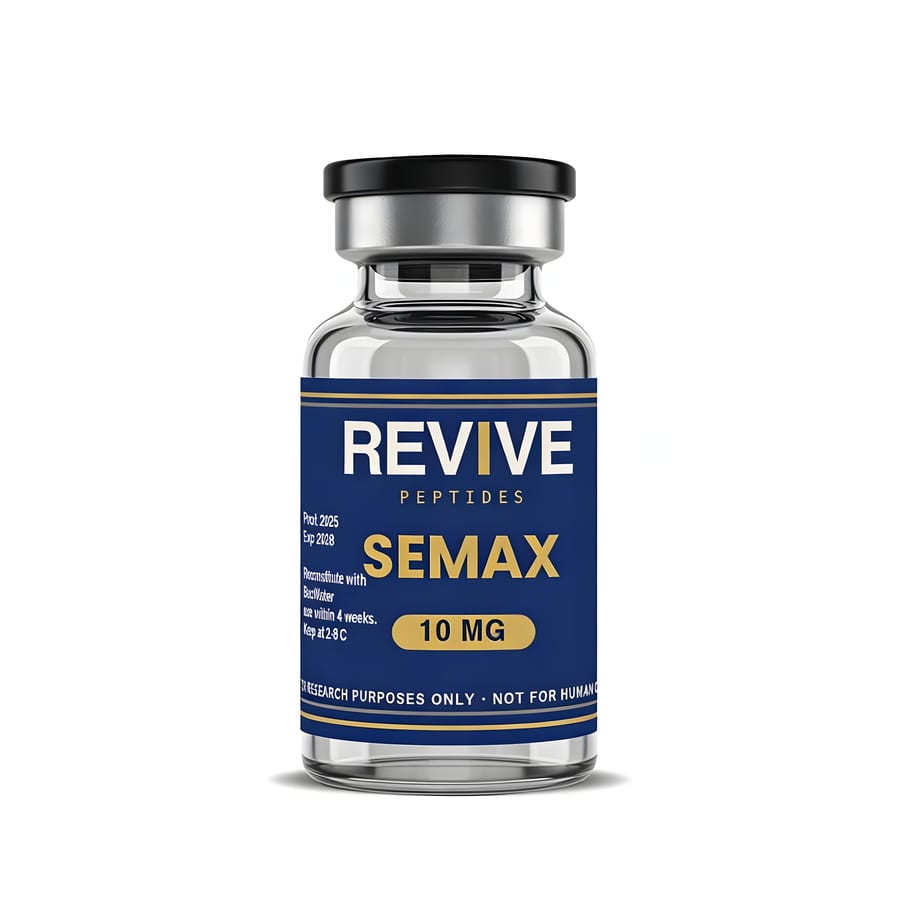
Semax Research Vial — Specifications at REVIVE
| Spec | Detail |
|---|---|
| Format | 10 mg lyophilised vial |
| Molecular weight | ≈ 813 Da |
| Purity (HPLC) | ≥ 98.5% |
| Sequence | Heptapeptide — Met-Glu-His-Phe-Pro-Gly-Pro |
| Storage (lyophilised) | −20°C, desiccated |
| Reconstitution | Sterile or bacteriostatic water, 2–3 mL, laboratory preparation only |
| Intended use | Laboratory research reference material only — not for human or veterinary use |
| Price | AED 249 |
Reconstitution here refers strictly to the laboratory step of dissolving lyophilised powder into solution for storage and further research handling — this page provides no guidance on how any resulting solution would be applied, dosed, or administered.
HPLC-verified ≥98.5% purity, 10 mg lyophilised vial, sold strictly for laboratory research use.
View Semax research specifications →
Why This Matters for UAE Research Buyers
UAE-based academic and private research groups increasingly want to see a compound's published research trail before requesting it for a study protocol — not because a vendor summary is a substitute for primary literature, but because it helps triage which compounds merit deeper investigation. Semax's decades-long, institutionally consistent research trail through Myasoedov and IMG RAS is one reason it remains a frequently requested reference compound among researchers working in neuropharmacology-adjacent fields regionally.
REVIVE Peptides' role in that pipeline is narrow and deliberate: supplying an HPLC-verified, correctly labelled Research Use Only reference vial, and pointing researchers toward the literature rather than substituting for it. For the underlying pharmacology, see our companion piece on Semax mechanism of action research, and for practical buyer questions see our Semax research FAQ for UAE buyers.
Notes on sourcing
- This review attributes the origin of Semax generally to Nikolay F. Myasoedov and the Institute of Molecular Genetics, Russian Academy of Sciences, consistent with the widely documented history of the compound's development within Russian neuropharmacology research.
- Specific journal, volume and page-level citations are intentionally omitted where REVIVE Peptides cannot independently verify them — researchers should conduct their own primary-source literature search before relying on any claim.
- No dose-outcome figures are restated in this article, consistent with REVIVE Peptides' research-use-only compliance policy.