Semax Mechanism of Action: ACTH(4-10) Pharmacology and Neurotrophic Signalling Research (2026)
Starting From Structure: What Makes Semax an ACTH(4-10) Analogue
To understand why Semax research diverges so sharply from classical hormone pharmacology, it helps to start with the parent molecule. Adrenocorticotropic hormone (ACTH) is a 39-amino-acid peptide hormone whose full-length structure is responsible for stimulating cortisol release from the adrenal cortex. Research dating back decades established that this hormonal, corticotropic activity is concentrated in specific regions of the full ACTH sequence — and that shorter fragments, including the ACTH(4-10) heptapeptide, retain central-nervous-system signalling relevance while research indicates they lack the adrenal-stimulating hormonal activity of the intact hormone.
Semax is built on that ACTH(4-10) fragment (sequence Met-Glu-His-Phe-Pro-Gly-Pro corresponds to the core plus a Myasoedov-group extension), with a proline-glycine-proline tripeptide appended at the C-terminus. That addition is the key structural modification credited to the IMG RAS programme — research literature associates it with altering the molecule's enzymatic stability profile relative to the unmodified ACTH(4-10) fragment, which degrades rapidly via peptidase activity in biological systems. Molecular weight of the resulting heptapeptide is approximately 813 Da.
Why "Non-Hormonal" Matters to the Research Question
A recurring theme across Semax research literature is the effort to separate the molecule's studied central-nervous-system activity from classical hormonal signalling. Because Semax is derived from a fragment of ACTH rather than the intact hormone, research has focused on whether — and how — it engages neural signalling pathways independent of the hypothalamic-pituitary-adrenal axis activity associated with full-length ACTH. This distinction is central to why Semax occupies its own research category rather than being treated as a corticosteroid-adjacent compound.
Neurotrophic Signalling: The BDNF Research Thread
One of the more frequently cited threads in Semax mechanistic literature concerns neurotrophic factor signalling — specifically, research examining Semax's studied relationship to brain-derived neurotrophic factor (BDNF) expression and related neurotrophic pathways. BDNF itself is a well-characterised protein broadly studied across neuroscience for its role in neuronal survival, synaptic plasticity and neural growth signalling.
Research on Semax in this area has generally examined:
- Expression-level research questions. Studies have investigated whether Semax exposure is associated with changes in neurotrophic factor expression in various research models, as part of the broader Myasoedov-programme interest in neuroprotective and cognitive signalling.
- Downstream signalling cascade research. Neurotrophic factors like BDNF operate through receptor tyrosine kinase pathways with downstream effects on gene transcription relevant to synaptic function — an area of general neuroscience research that Semax-specific studies have intersected with.
- Comparative peptide-class research. Semax is frequently discussed alongside other short neuropeptides studied for neurotrophic-adjacent signalling, situating it within a broader research category rather than as an isolated compound.
Consistent with REVIVE Peptides' compliance policy, this section deliberately avoids restating specific percentage changes, effect sizes, or dose-linked outcome figures from any individual study. Researchers seeking that level of granularity should consult primary sources directly and evaluate methodology and statistical power themselves.
Receptor Pharmacology: An Open Research Question
Unlike many well-characterised peptides with a single clearly mapped receptor, part of what makes Semax scientifically interesting to researchers is that its precise receptor-level mechanism remains an active area of published inquiry. Research has explored possible interactions with melanocortin-receptor-adjacent signalling (given the ACTH lineage) as well as broader neuromodulatory pathways, without a single, universally agreed-upon receptor mechanism fully closing the question. This is a useful point for researchers designing new studies: Semax's mechanism-of-action literature is still an active, evolving research area rather than a fully settled one.
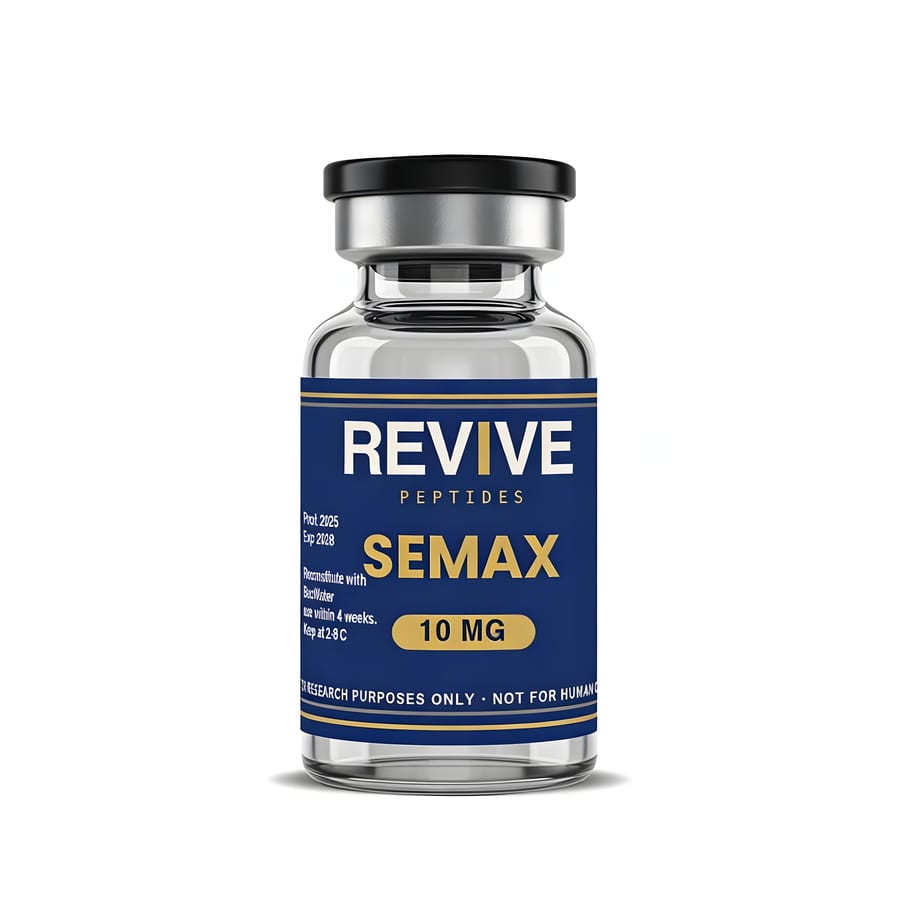
Semax Research Vial — Specifications at REVIVE
| Spec | Detail |
|---|---|
| Format | 10 mg lyophilised vial |
| Molecular weight | ≈ 813 Da |
| Purity (HPLC) | ≥ 98.5% |
| Sequence | Heptapeptide — Met-Glu-His-Phe-Pro-Gly-Pro |
| Structural class | ACTH(4-10) analogue with C-terminal Pro-Gly-Pro extension |
| Storage (lyophilised) | −20°C, desiccated |
| Reconstitution | Sterile or bacteriostatic water, 2–3 mL, laboratory preparation only |
| Intended use | Laboratory research reference material only — not for human or veterinary use |
| Price | AED 249 |
ACTH(4-10) analogue heptapeptide, HPLC-verified ≥98.5% purity, sold strictly for laboratory research use.
View Semax research specifications →
Why Mechanism Research Matters More Than Marketing Claims
For a compound like Semax, mechanism-of-action literature is arguably more valuable to a serious researcher than any outcome claim, because it tells you whether the proposed biological rationale for a study is coherent before you invest time designing a protocol around it. The ACTH(4-10) lineage, the Pro-Gly-Pro stability modification, and the still-open receptor question are the three structural facts every researcher evaluating Semax should verify independently against primary literature rather than take on trust from any vendor, including REVIVE.
For the broader published-research landscape around this compound, including its institutional origin at IMG RAS, see our companion piece on Semax clinical trial literature review. For practical buyer and storage questions, see our Semax research FAQ for UAE buyers.
Notes on sourcing
- Structural and institutional attribution in this article is based on the widely documented history of Semax's development by Nikolay F. Myasoedov and colleagues at the Institute of Molecular Genetics, Russian Academy of Sciences.
- Specific journal, volume and page-level citations are intentionally omitted where REVIVE Peptides cannot independently verify them — researchers should conduct their own primary-source literature search before relying on any claim.
- No dose-outcome figures are restated in this article, consistent with REVIVE Peptides' research-use-only compliance policy.