TB-500 & Rotator Cuff Injury Research: What Investigators Have Found and Where to Buy TB-500 UAE (2026 Review)
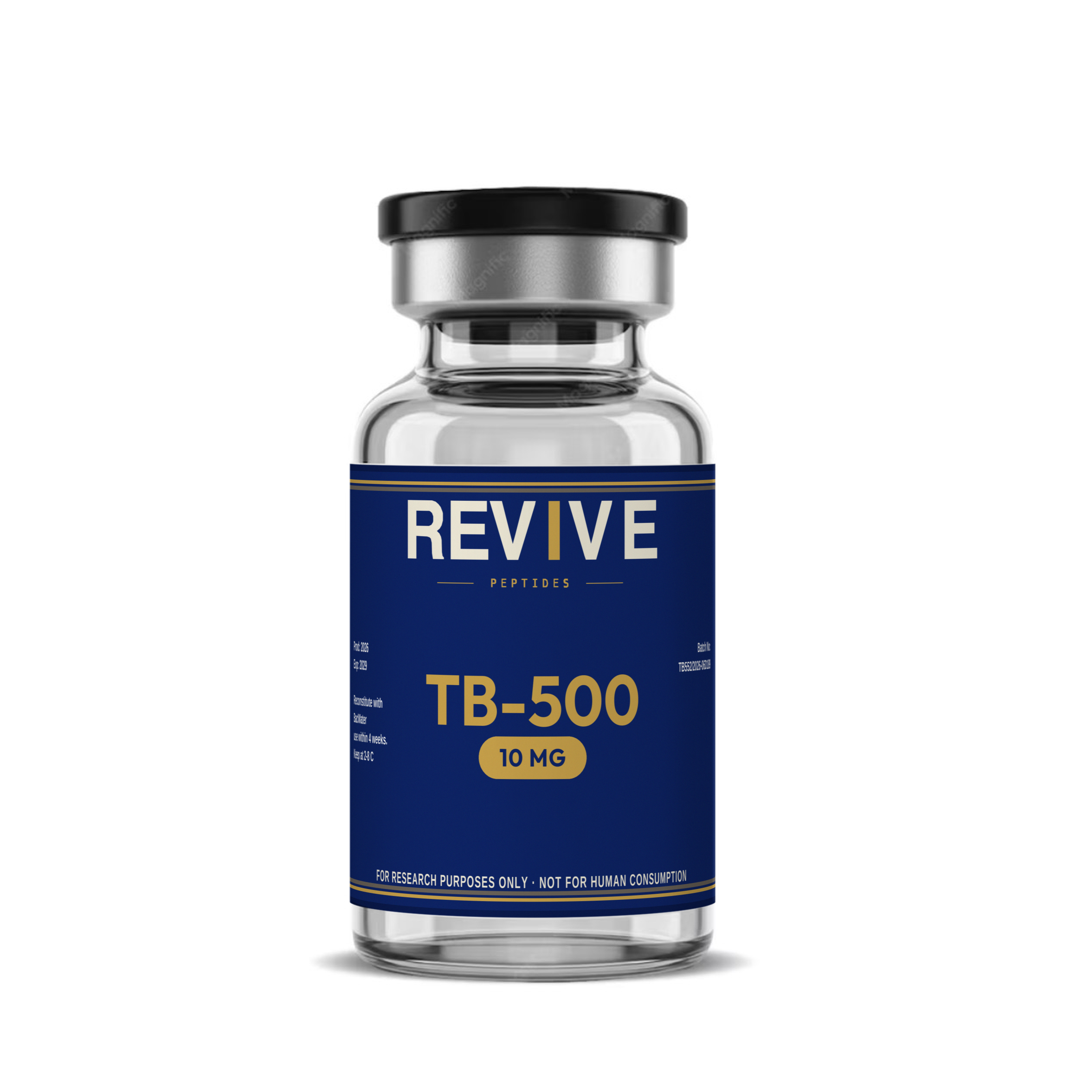
The rotator cuff is not a single structure — it is four tendons (supraspinatus, infraspinatus, subscapularis, teres minor) converging on the humeral head, each chronically loaded in ways that outpace the tissue's regenerative capacity. Investigators studying connective tissue repair have increasingly turned to thymosin beta-4, the peptide encoded in the commercially available TB-500 format, because of its unusually broad signalling footprint: it touches actin dynamics, angiogenesis, inflammation modulation, and tenocyte migration simultaneously. For researchers in the UAE looking to work with this molecule, buy TB-500 UAE supply is now straightforward through REVIVE LAB UAE — but the research context deserves a careful read before any study is designed.
What Is TB-500? The Thymosin Beta-4 Mechanism Explained
TB-500 is a synthetic fragment corresponding to the active region of thymosin beta-4 (Tβ4), a ubiquitous intracellular protein first identified in thymic tissue and later found to be one of the most abundant peptides in mammalian cells. Its primary biochemical role is actin sequestration — it binds G-actin monomers, directly influencing the rate and directionality of actin filament polymerization. Because actin dynamics underlie virtually every process involving cell shape change and migration, Tβ4's downstream effects are broad by design.
Goldstein and colleagues described in their thymosin beta-4 research how Tβ4 promotes cell survival and migration through the Akt/PI3-kinase pathway, upregulates matrix metalloproteinases (MMPs) for extracellular matrix remodelling, and stimulates proangiogenic signalling via VEGF. In tissue-repair research models, this profile translates to three operationally important effects:
- Tenocyte and fibroblast recruitment — Tβ4 increases the migratory speed of fibroblasts toward injury sites, a rate-limiting step in early tendon repair.
- Collagen matrix reorganization — by modulating MMP expression, it helps investigators probe how collagen fibril orientation recovers after mechanical injury.
- Angiogenic support — tendons are notoriously hypovascular; the VEGF-mediated angiogenic signal Tβ4 promotes is of direct interest in avascular-zone injury models.
Crockford and colleagues placed thymosin beta-4 in a broader clinical research context, noting the peptide's anti-inflammatory properties alongside its regenerative signalling and highlighting the safety data accumulated in early investigational work. It is this combination — repair promotion without the proliferative risk profile of growth factors — that keeps Tβ4 prominent in peptide research portfolios.
Why Rotator Cuff Research? The Tissue-Repair Problem TB-500 Addresses
Rotator cuff pathology presents a specific biological challenge that makes it a useful model system for connective tissue investigators. Three features make it analytically interesting:
1. Hypovascular Zones and Healing Limits
The critical zone of the supraspinatus tendon — the area most commonly implicated in partial and full-thickness tears — is notably hypovascular. Standard wound-healing cascades rely on blood-borne progenitor cells and growth factors arriving at the injury site. In hypovascular tendon zones, this delivery mechanism is compromised. Researchers studying Tβ4 in tendon models are specifically interested in whether its angiogenic signalling can modulate the vascular response upstream of tissue repair.
2. Fibroblast-to-Tenocyte Differentiation Pathways
Tendon repair does not restore original tissue architecture by default — it produces mechanically inferior scar tissue dominated by type III collagen rather than the parallel type I collagen fibrils of native tendon. Investigator interest in Tβ4 in this context focuses on its reported ability to promote tenocyte-lineage differentiation and organized collagen fibril deposition, as reviewed in the Goldstein research literature.
3. Inflammatory Modulation Without Immunosuppression
Chronic rotator cuff pathology is accompanied by a persistent low-grade inflammatory environment that paradoxically impairs the repair process. Tβ4's documented anti-inflammatory effects — particularly its suppression of NF-κB-mediated inflammatory signalling — make it relevant to studies probing whether inflammation modulation can shift the tissue toward a regenerative rather than degenerative trajectory. Crockford and colleagues specifically addressed this anti-inflammatory dimension as one of the key reasons Tβ4 had advanced from basic research into investigational study designs.
Buy TB-500 UAE — Order Now →
TB-500 Research Findings at a Glance
The following table summarises the key mechanistic endpoints most relevant to rotator cuff tissue research as described in the thymosin beta-4 literature, including the Goldstein research review and Crockford clinical context research.
| Research Endpoint | Tβ4 Mechanism | Relevance to Tendon Models | Key Source |
|---|---|---|---|
| Cell migration & recruitment | Actin G-monomer sequestration; Akt/PI3K activation | Accelerates fibroblast/tenocyte arrival at injury site | Goldstein et al. |
| Angiogenesis | VEGF upregulation; endothelial progenitor recruitment | Critical in hypovascular supraspinatus critical zone | Goldstein et al. |
| Inflammation modulation | NF-κB suppression; anti-apoptotic signals | Shifts chronic inflammatory milieu toward repair phase | Crockford et al. |
| Collagen matrix remodelling | MMP upregulation; extracellular matrix turnover | Probe for collagen fibril reorganisation post-injury | Goldstein et al. |
| Stem/progenitor cell activation | Promotes cardiac and skeletal progenitor differentiation | Relevant to tenocyte-lineage differentiation research | Crockford et al. |
REVIVE LAB UAE supplies TB-500 10mg vials — the only stocked strength — to registered researchers and institutions. No other strengths are carried; investigators requiring a different unit should contact the research desk before ordering. REVIVE LAB UAE does not publish dosing, loading-schedule, or injection-frequency guidance for TB-500 or any compound; researchers should determine their own protocol design in line with the primary literature and their institution's research oversight.
Reconstitution Notes for Research Use
Lyophilized TB-500 vials should be reconstituted with bacteriostatic water (BAC water), adding solvent slowly down the side of the vial to avoid mechanical shearing of the peptide. Reconstituted vials should be stored at 2-8°C and used within 14 days. Lyophilized stock is stable at 2-8°C for the duration of the labelled shelf life. REVIVE LAB UAE ships all TB-500 vials in validated cold-chain packaging — maintaining 2-8°C through any UAE summer transit — with each lot accompanied by a certificate of analysis confirming HPLC-verified purity.
How TB-500 Compares to Other Peptides in Musculoskeletal Research
Researchers designing studies on tendon and connective tissue repair often consider TB-500 alongside other peptides with overlapping tissue-repair profiles. The table below compares key characteristics relevant to rotator cuff and shoulder tendon research models.
| Peptide | Primary Mechanism | Tendon Relevance | UAE Availability |
|---|---|---|---|
| TB-500 (thymosin beta-4) | Actin regulation, angiogenesis, anti-inflammatory | Direct: tenocyte migration, collagen remodelling | 10mg vials, in stock |
| BPC-157 | Growth hormone receptor upregulation, tendon-to-bone interface | Direct: tendon-bone junction healing models | In stock UAE |
| GHK-Cu | Copper tripeptide, collagen synthesis, antioxidant | Indirect: matrix support, anti-fibrotic signals | In stock UAE |
| Retatrutide | GLP-1/GIP/glucagon triple agonist | Indirect: metabolic load reduction in obesity models | In stock UAE |
TB-500's distinguishing feature in this context is the breadth of its signalling. Most tissue-repair peptides work through a single dominant pathway; Tβ4 simultaneously addresses cell migration, vascularity, inflammation, and matrix remodelling — which is why investigators studying complex connective tissue injuries often position it as a foundational molecule in multi-peptide research designs.
Order TB-500 UAE — Buy Now →
Buy TB-500 UAE — REVIVE LAB UAE Stock and Delivery
REVIVE LAB UAE supplies HPLC-verified, lot-COA, cold-chain dispatched TB-500 across all 7 emirates. The supply chain is Dubai-based — not a drop-ship intermediary — which is what makes TB-500 same day Dubai delivery operationally possible. Orders placed before the daily cut-off are dispatched with refrigerated couriers and arrive cold. For researchers outside Dubai, next-day delivery reaches every other emirate within 24 hours.
| Emirate / City | Delivery Window | Cash on Delivery | Cold-Chain Packaging |
|---|---|---|---|
| Dubai (Marina, JBR, Business Bay, DIFC, JVC, Downtown, Palm, Jumeirah) | Same-day, 4-8 hours | Yes | Yes |
| Abu Dhabi (Corniche, Yas, Saadiyat, Reem Island) | Next-day, 18-24 hours | Yes | Yes |
| Sharjah | Same-day / next-day, 8-18 hours | Yes | Yes |
| Ajman | Next-day, 18-24 hours | Yes | Yes |
| Ras Al Khaimah (RAK) | Next-day, 18-24 hours | Yes | Yes |
| Fujairah | Next-day, 24 hours | Yes | Yes |
| Umm Al Quwain (UAQ) | Next-day, 18-24 hours | Yes | Yes |
| Al Ain | Next-day, 24 hours | Yes | Yes |
Payment options include cash on delivery across the UAE, bank transfer, and — for researchers preferring digital settlement — USDT (TRC20) via Binance Pay with a 5% pre-pay discount applied automatically. Every TB-500 10mg vial leaves the Dubai dispatch facility at 2-8°C, packed in validated insulated carriers. This is what TB-500 Dubai 24h delivery looks like when the supplier is actually on the ground rather than routing through a third-country freight hub. For the broader REVIVE LAB UAE peptides research catalogue — including Retatrutide, Tesamorelin, GHK-Cu, BPC-157, and MOTS-c — see the full product list.
FAQ
What TB-500 strength does REVIVE LAB UAE stock for rotator cuff research?
REVIVE LAB UAE stocks TB-500 exclusively in 10mg vials (AED 399) — HPLC-verified for purity, issued with a lot-specific certificate of analysis, and dispatched in cold-chain validated packaging. Researchers looking to buy TB-500 in stock UAE can place same-day orders in Dubai or next-day to any other emirate.
Where can I buy TB-500 with 24h delivery in the UAE?
REVIVE LAB UAE supplies HPLC-verified, lot-COA, cold-chain dispatched TB-500 10mg vials across all 7 emirates. TB-500 same day Dubai dispatch is available for orders placed before the daily cut-off. Abu Dhabi, Sharjah, Ajman, RAK, Fujairah, UAQ and Al Ain receive next-day delivery within 24 hours. Cash on delivery Dubai is supported as standard. USDT crypto pay is also accepted for digital settlement.
Buy TB-500 UAE — Order Now →
- Goldstein AL and colleagues. Published research on thymosin β4 as a multi-functional regenerative peptide, covering its basic biochemical properties and research applications.
- Crockford D and colleagues. Published research on thymosin beta4 structure, function, and biological properties relevant to ongoing research applications.