MOTS-c Mechanism of Action: How AMPK Pathway and Metabolic Signaling Research Works (2026)
Starting Point: A Peptide Encoded Inside the Mitochondrial Genome
Most cellular proteins and peptides are encoded by nuclear DNA. MOTS-c is a notable exception — it is encoded within mitochondrial DNA, in a region overlapping the 12S ribosomal RNA gene, rather than in the mitochondrial genes classically known for encoding electron-transport-chain proteins. This origin is the starting point for understanding why MOTS-c is mechanistically interesting to researchers: it represents evidence that mitochondria, long understood primarily as energy-producing organelles, can also generate peptides capable of participating in broader cell-signaling processes.
Changhan Lee and colleagues' 2015 characterization established MOTS-c's identity and opened the mitochondrial-derived-peptide field to focused mechanistic study. Since then, published research has concentrated heavily on one specific downstream pathway: AMPK.
AMPK Pathway Activation — The Core Mechanism Studied
AMP-activated protein kinase (AMPK) is one of the most extensively studied cellular energy-sensing systems in biology. It functions as a metabolic checkpoint — when a cell's energy status shifts, AMPK activation triggers a cascade of downstream changes affecting how the cell manages energy production and consumption. Because AMPK sits at such a central position in cellular metabolism, any peptide shown to interact with this pathway becomes an immediate research subject of interest.
Published research following Lee's initial characterization describes MOTS-c as a peptide studied for its relationship to AMPK activation in laboratory models. The mechanistic proposal explored in this literature is that MOTS-c, originating from the mitochondria itself, may act as a signal that communicates the mitochondrion's functional status to the broader cellular energy-sensing machinery — effectively linking mitochondrial biology directly to the AMPK checkpoint system.
Why this mitochondria-to-AMPK link matters mechanistically
Traditionally, AMPK activation has been studied primarily in response to whole-cell energy signals — shifts in the ratio of AMP to ATP, for instance. MOTS-c research adds a more specific proposed input: a peptide signal originating directly from the mitochondrial genome. This is what makes MOTS-c mechanistically distinct from most other metabolically relevant research peptides, and why it continues to be studied as a potential missing link between mitochondrial function and cell-wide energy-sensing pathways.
Metabolic Signaling Research More Broadly
Beyond the specific AMPK connection, MOTS-c is studied within a wider metabolic-signaling research context. Because AMPK activation triggers numerous downstream effects relevant to how cells regulate energy substrates, laboratories studying MOTS-c often place it within broader experimental models examining cellular metabolic regulation — using cell-culture and laboratory-animal models to explore how MOTS-c-related signaling intersects with established metabolic research pathways.
This research direction connects back to the "mitochondrial-nuclear communication" concept discussed in the broader MOTS-c literature: the idea that mitochondrially-encoded signals like MOTS-c may participate in feedback loops that ultimately influence gene expression programs relevant to cellular metabolism, studied entirely within laboratory settings.
Mitochondrial-Derived Peptide Biology as a Research Category
MOTS-c belongs to a small but growing category of mitochondrial-derived peptides (MDPs) identified since the early 2000s. Understanding MOTS-c's mechanism requires situating it within this category: MDPs are peptides encoded by short open reading frames within mitochondrial DNA that were historically overlooked because mitochondrial genes were assumed to encode only components of the electron transport chain and structural RNAs. Lee's characterization of MOTS-c was part of the broader research effort demonstrating that this assumption was incomplete, and the mechanistic study of MOTS-c continues to inform how researchers think about the wider MDP category.
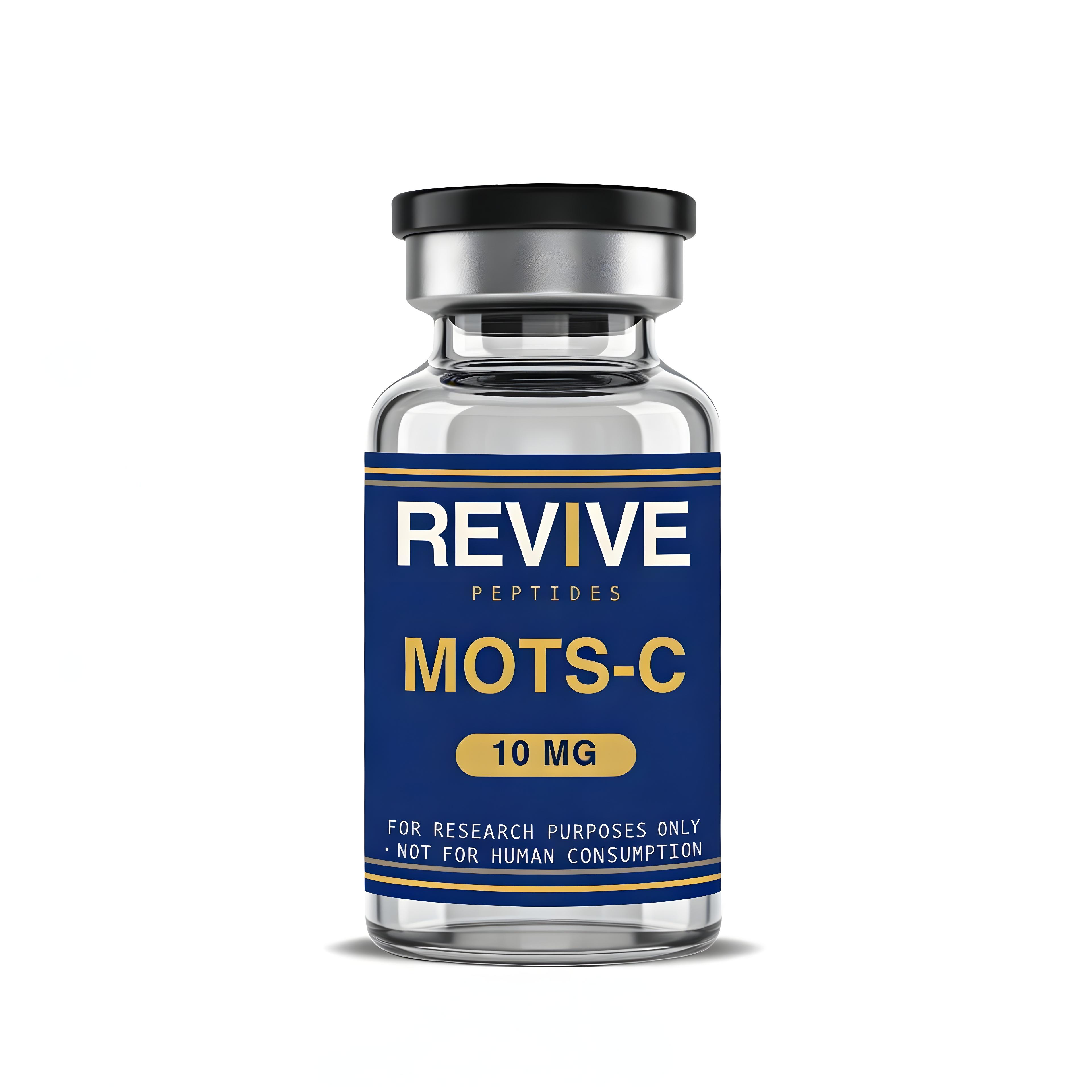
MOTS-c Vial Specifications at REVIVE LAB UAE
| Spec | MOTS-c 10 mg vial |
|---|---|
| Form | Lyophilised powder |
| Sequence | Mitochondrial-derived peptide, 16 amino acids |
| Molecular weight | ≈2174 Da |
| Purity (HPLC) | ≥98.0% |
| Reconstitution | Bacteriostatic water, 2–3 mL |
| Storage (lyophilised) | −20°C, desiccated |
| Labelling | Research Use Only — not for human or veterinary use |
| Price | AED 750 |
HPLC-verified, ≥98.0% purity, 16-amino-acid mitochondrial-derived peptide. Sold strictly as a laboratory research reference material.
View MOTS-c product page →
Why Mechanism Research Does Not Translate Into Usage Guidance
As with every research peptide covered on this site, it is worth being explicit about a boundary REVIVE LAB UAE maintains deliberately: understanding a molecular mechanism in a laboratory model is not the same as understanding a safe or effective way to administer a compound to a living organism. This article stops at describing cellular and molecular biology. It does not, and will not, provide dosing amounts, injection frequency, or any other administration guidance — because MOTS-c sold here is not evaluated, approved or intended for that purpose.
What researchers should take from this
- Mechanism research describes molecular interactions observed in laboratory models, not outcomes in living organisms.
- MOTS-c is a research reference compound — reconstitution instructions describe laboratory sample preparation only.
- Any research protocol design should be built directly from primary published literature and institutional review, not from marketing or blog content.
References
- Lee C, and colleagues. Initial characterization of MOTS-c, a mitochondrial-derived peptide, circa 2015 — mitochondrial-nuclear communication and AMPK-pathway research relevance. General attribution; researchers should consult primary published sources directly for full citation details.
- Lee C, Zeng J, Drew BG, et al. Research on mitochondrial-derived peptides and metabolic regulation.