Semax Research FAQ: Purity, Legality and Storage Questions From UAE Researchers (2026)
General Questions
What is Semax?
Semax is a synthetic heptapeptide — sequence Met-Glu-His-Phe-Pro-Gly-Pro, molecular weight approximately 813 Da — developed within a Russian neuropharmacology research programme associated with Nikolay F. Myasoedov and the Institute of Molecular Genetics, Russian Academy of Sciences. It is structurally an analogue of ACTH(4-10), a fragment of adrenocorticotropic hormone studied for central-nervous-system signalling relevance distinct from ACTH's hormonal function. For the underlying pharmacology, see our Semax mechanism of action research review.
Why do researchers request Semax specifically?
Researchers working in neuropharmacology-adjacent fields request Semax because of its decades-long, institutionally consistent published research trail — a rarity among synthetic research peptides. Our Semax clinical trial literature review covers the scope of that published trail in more depth.
Does REVIVE provide dosing or usage instructions for Semax?
No. REVIVE Peptides does not provide dosing, administration, application-method, or self-use guidance for Semax or any compound in its catalogue, under any circumstances. All REVIVE content is limited to product specifications, published-research context, and laboratory handling information such as storage and reconstitution (dissolving powder into solution) as a preparatory laboratory step — not instructions for use.
Purity and Verification
How does REVIVE verify Semax purity?
Each Semax batch supplied by REVIVE is verified by HPLC (high-performance liquid chromatography), the standard analytical method for confirming peptide purity and identity in the research-chemical supply chain. REVIVE's Semax vials carry a minimum verified purity of 98.5%, with a lot-specific certificate of analysis (COA) available for researchers who need it for their own institutional documentation.
What does a certificate of analysis actually show?
A COA documents the HPLC purity result for the specific manufacturing lot, along with batch identification and manufacture date. It is the standard way a research-chemical buyer independently confirms that what arrived matches what was ordered, rather than relying on vendor claims alone. Serious researchers should always request and retain the COA for their records.
Why does HPLC purity matter for a compound like Semax?
Because Semax research is mechanistically specific — tied to its exact heptapeptide sequence and the ACTH(4-10)-derived structure discussed in our mechanism review — impurities or degradation products can materially change what a research sample actually contains. HPLC verification is the baseline standard the research-chemical field uses to confirm sequence-level integrity before a compound is used in any study protocol.
Buying Semax in the UAE
Is it legal to buy Semax as a research chemical in the UAE?
REVIVE Peptides sells Semax in the UAE strictly as a research-use-only laboratory reference material — labelled accordingly, marketed to researchers and institutions, and not sold or marketed for human or veterinary consumption. As with any research chemical, buyers are responsible for ensuring their specific intended use complies with their institution's research protocols and all applicable UAE laws and regulations. This FAQ is general information only and is not legal advice; researchers with specific compliance questions should consult their institution's regulatory affairs office.
Who is REVIVE's Semax intended for?
REVIVE's Semax vials are intended for qualified researchers, laboratories, and research institutions conducting in-vitro or other laboratory-based research work. They are explicitly not intended for human or veterinary use, self-experimentation, or consumption of any kind.
What documentation comes with a Semax order?
Each vial ships with a lot-specific HPLC certificate of analysis, batch number, manufacture date, and research-use-only labelling, consistent with standard practice across REVIVE's research-peptide catalogue.
Storage and Handling
How should Semax be stored?
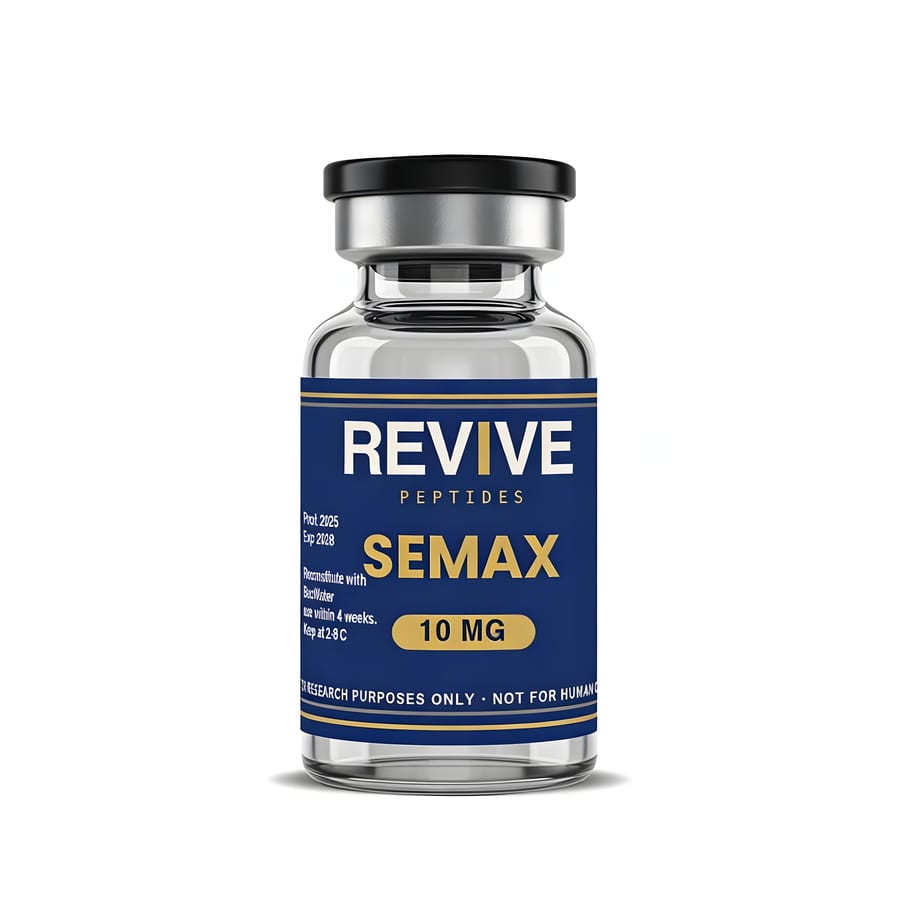
REVIVE ships Semax as a lyophilised (freeze-dried) 10 mg vial. Recommended storage prior to laboratory use is −20°C, desiccated, to preserve peptide integrity. This is a storage instruction only — it does not describe how any reconstituted solution would be used or applied.
What does "reconstitution" mean in a research context?
Reconstitution refers to the laboratory step of dissolving the lyophilised peptide powder into a liquid carrier — for Semax, typically sterile or bacteriostatic water in the 2–3 mL range — to create a solution suitable for further laboratory handling or analytical work. This is a general lab-preparation description, not an administration or dosing instruction, and REVIVE does not provide guidance beyond this general laboratory-preparation description.
Does Semax need cold-chain shipping in UAE summer conditions?
Yes. Like other lyophilised research peptides, Semax is shipped with appropriate insulated packaging to protect it from UAE summer heat during transit, and should be moved to −20°C storage promptly on arrival.
Semax Research Vial — Specifications at REVIVE
| Spec | Detail |
|---|---|
| Format | 10 mg lyophilised vial |
| Molecular weight | ≈ 813 Da |
| Purity (HPLC) | ≥ 98.5% |
| Sequence | Heptapeptide — Met-Glu-His-Phe-Pro-Gly-Pro |
| Storage (lyophilised) | −20°C, desiccated |
| Reconstitution | Sterile or bacteriostatic water, 2–3 mL, laboratory preparation only |
| Documentation | Lot-specific HPLC certificate of analysis |
| Intended use | Laboratory research reference material only — not for human or veterinary use |
| Price | AED 249 |
HPLC-verified ≥98.5% purity, lot-specific COA, sold strictly for laboratory research use.
View Semax research specifications →
For the published-research background behind Semax, see our Semax clinical trial literature review and Semax mechanism of action research pieces.
Notes on sourcing
- Institutional and structural attribution in this FAQ is based on the widely documented history of Semax's development by Nikolay F. Myasoedov and colleagues at the Institute of Molecular Genetics, Russian Academy of Sciences.
- This FAQ does not constitute legal advice regarding UAE research-chemical regulations; researchers should consult their institution's regulatory affairs office for compliance questions specific to their use case.
- No dosing or administration questions are answered in this FAQ, consistent with REVIVE Peptides' research-use-only compliance policy.