TB-500 Shoulder & Overhead-Athlete Research: Joint and Soft-Tissue Context for UAE Investigators
Why the UAE's Overhead-Sport Boom Matters for Shoulder Research
Padel courts have multiplied across Dubai and Abu Dhabi faster than almost any other sport infrastructure in the region over the past two years, alongside an already-established tennis, swimming and golf base. All four sports share a mechanical signature: repeated overhead arm elevation loading the shoulder joint capsule, the surrounding soft tissue, and the stabilizing musculature well beyond what everyday movement demands. That volume of repetitive load is exactly the kind of pattern connective-tissue researchers use to build study models — and it's driven real interest among UAE-based investigators in peptides with a documented actin-binding and tissue-signalling profile.
The Joint-Capsule and Soft-Tissue Angle
Unlike a pure tendon-mechanism deep-dive, the research interest here sits one layer broader — at the level of the shoulder joint capsule and the surrounding soft-tissue envelope that overhead athletes load repeatedly across a season. Three features make this a distinct research angle worth separating from tendon-specific work:
1. Cumulative Micro-Load Rather Than Acute Injury
Overhead athletes rarely present with a single traumatic event — the research interest is in cumulative micro-load across the joint capsule and stabilizing soft tissue over months of repeated motion. That's a different study design problem than acute tear models, and it's where broader actin-regulation and cell-migration signalling research becomes relevant to investigators mapping recovery capacity under sustained load.
2. Multi-Structure Involvement
Shoulder mobility in overhead sport isn't isolated to one structure — the capsule, the surrounding musculature, and the stabilizing soft tissue all participate. Researchers interested in TB-500's actin-binding mechanism are often specifically drawn to its broad signalling footprint, since a single-pathway peptide would be a poor model fit for a multi-structure loading pattern.
3. Vascular Considerations in Joint-Capsule Tissue
Joint-capsule tissue, like tendon, tends toward lower baseline vascularity than muscle. The angiogenesis-related signalling associated with Thymosin β-4 research — the general area of work published by Allan L. Goldstein and colleagues — is one of the reasons this peptide keeps appearing in soft-tissue and joint-capsule study designs across sports-adjacent research groups.
See full TB-500 specs →
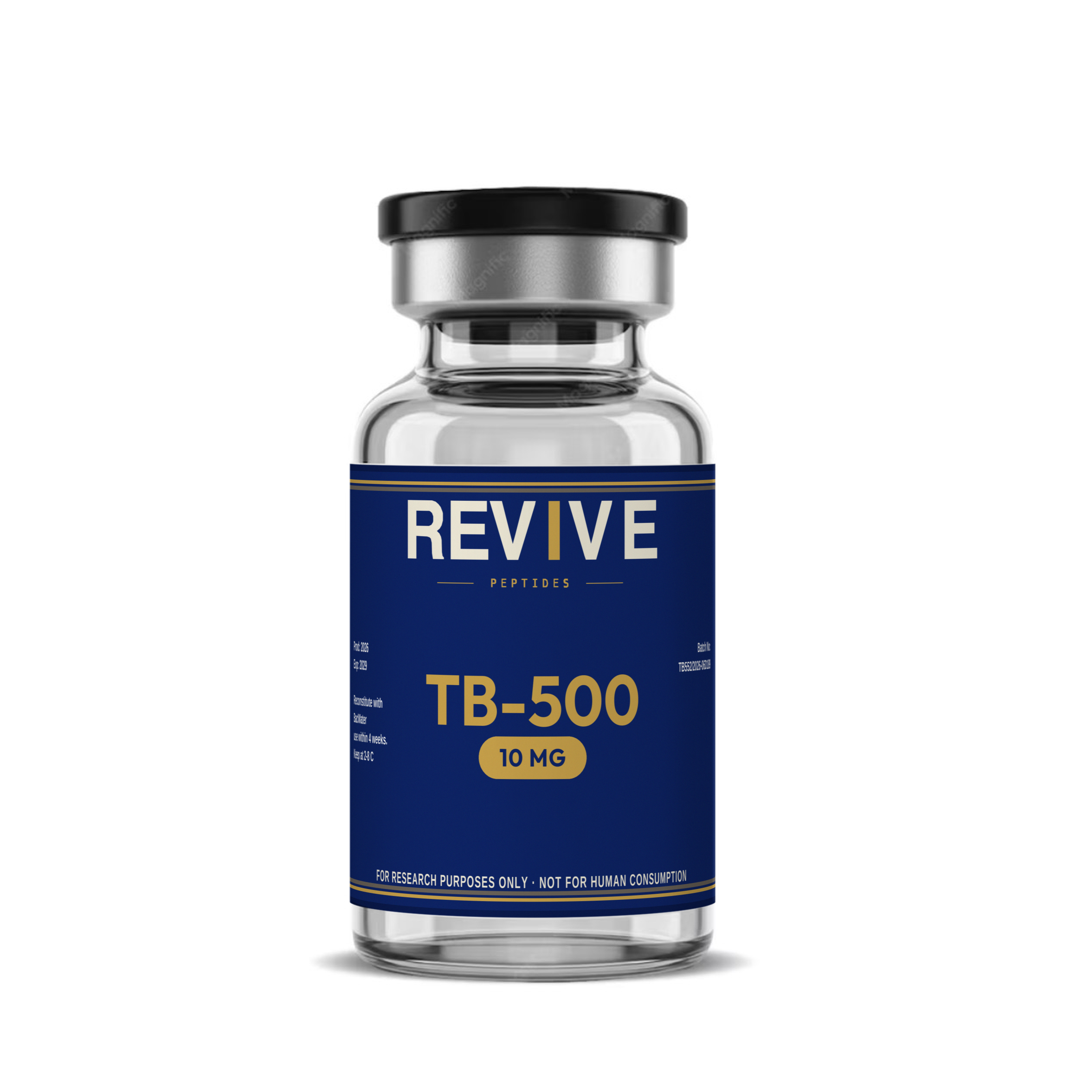
TB-500 at a Glance
| Spec | Detail |
|---|---|
| Strength | 10 mg vial |
| Price | AED 640 |
| Sequence | Thymosin β-4 fragment — 17 amino acids, LKKTETQ actin-binding motif |
| Molecular weight | ≈ 1880 Da |
| Purity (HPLC) | ≥ 98.8% |
| Form | White lyophilized powder |
| Storage (lyophilized) | −20°C, desiccated |
| Reconstitution | 2–3 mL bacteriostatic water |
Reconstitute by adding bacteriostatic water slowly down the vial wall, swirl — never shake — and refrigerate immediately. This is lab-prep guidance only. REVIVE does not provide dosing, injection-frequency or self-administration instructions for any research application, including shoulder or joint-capsule study designs.
UAE-Wide Delivery — Dubai and Abu Dhabi, Same 4 PM Rule
Whether a research group is based courtside at a Dubai padel club or working out of an Abu Dhabi sports-medicine research facility, the ordering rule is identical: confirm before 4 PM and REVIVE dispatches the same day.
| Emirate / Area | Delivery window | Cut-off time | Packaging |
|---|---|---|---|
| Dubai (all zones) | Same-day | 4 PM | Insulated + gel pack |
| Abu Dhabi (all zones) | Same-day | 4 PM | Insulated + double gel pack |
| Sharjah & Ajman | 24 hours | 4 PM | Insulated + gel pack |
| Northern Emirates (RAK, Fujairah, UAQ) | 1–2 business days | 4 PM | Reinforced cold-chain |
Ordering steps
- Order at /peptides/tb-500.html — TB-500 10mg, AED 640.
- Enter your Dubai or Abu Dhabi delivery address.
- Confirm before 4 PM for same-day dispatch to either Dubai or Abu Dhabi.
- Track your cold-chain courier and sign on arrival.
- Refrigerate the lyophilized vial at −20°C, desiccated, promptly on receipt.
Buy TB-500 UAE →