Tesamorelin for Fatty Liver and MASH: Complete UAE Research Review 2026
Why Tesamorelin Targets Liver Fat
Tesamorelin is a GHRH (growth hormone releasing hormone) analogue. It stimulates pulsatile endogenous GH secretion, which raises IGF-1, which drives:
- Hepatic lipid mobilisation
- Free fatty acid oxidation
The visceral preference is what makes tesamorelin unique among lipolytic peptides. Most GH-related interventions reduce all body fat; tesamorelin pulls specifically from visceral and hepatic stores, the two depots most metabolically harmful.
The Stanley 2019 Liver Trial
| Parameter | Detail |
|---|---|
| Citation | Stanley TL et al. Lancet HIV 2019 |
| Design | 12-month double-blind RCT |
| Subjects | 61 adults with HIV-associated NAFLD |
| Dose | 2 mg SC daily |
| Primary outcome | Hepatic fat fraction by MR spectroscopy |
| Result | −32% hepatic fat vs placebo +1% |
| Secondary outcomes | Reduced fibrosis markers, improved NAFLD activity score |
Earlier Foundation — Stanley 2014
Stanley 2014 (JAMA) established the visceral fat reduction with tesamorelin in HIV lipodystrophy — 18% visceral adipose tissue reduction at 6 months. This trial preceded and predicted the liver findings. See our Stanley 2014 deep dive.
Non-HIV Fatty Liver — Smaller Trials
Most published tesamorelin liver research is in HIV populations because that's where the original FDA approval indication sits. For non-HIV NAFLD/MASH, smaller studies and case reports exist:
- Bredella 2013: Showed visceral fat reduction in non-HIV abdominally obese subjects with tesamorelin.
- Falutz 2010 follow-up cohort: Hepatic indicators improved alongside visceral changes.
- Stanley 2012: IGF-1 dose-response in mixed-population studies.
The translation from HIV to non-HIV NAFLD assumes the mechanism (GHRH→GH→IGF-1→hepatic lipid mobilisation) operates similarly in non-HIV populations. Most experts consider this assumption reasonable but not proven.
Monitoring During Research
Long-term tesamorelin research protocols typically include:
- IGF-1 levels every 3 months — confirms mechanism activation; very high IGF-1 may indicate dose reduction needed
- Fasting glucose / HbA1c — GH can mildly reduce insulin sensitivity
- Liver enzymes (ALT/AST) — baseline and at 3, 6, 12 months
- Hepatic fat imaging — MR spectroscopy or FibroScan CAP if available
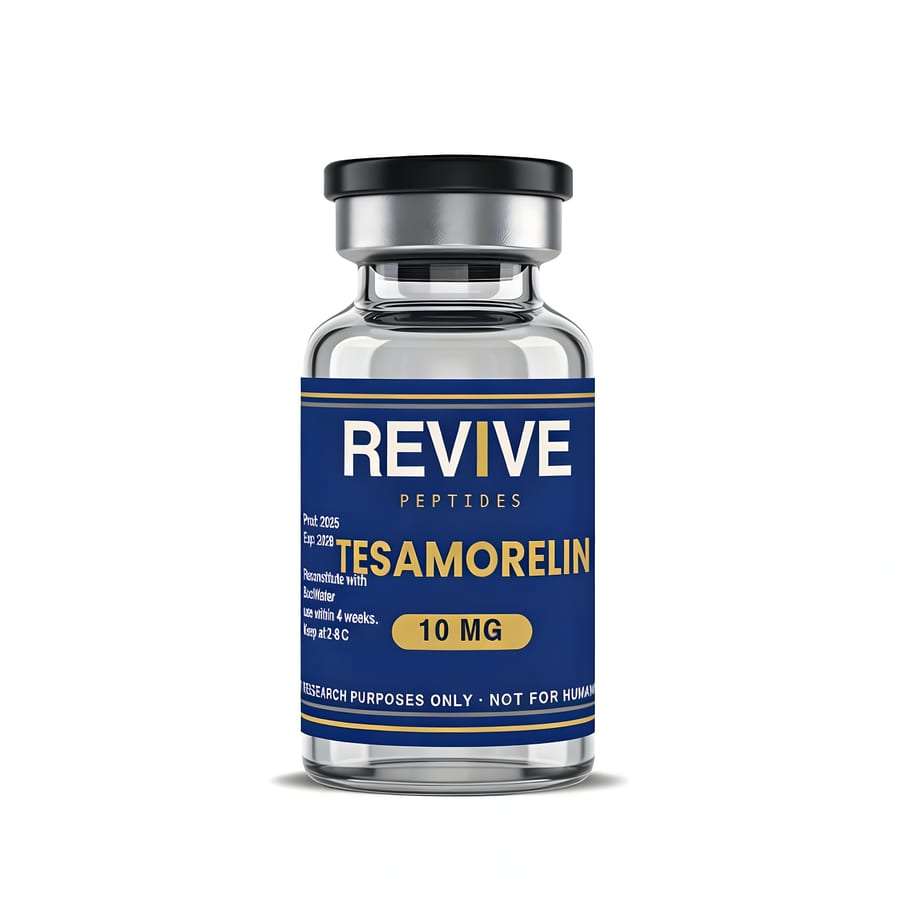
REVIVE supplies tesamorelin 5 mg and 10 mg with HPLC certificates and cold-chain delivery.
View tesamorelin vials →
Tesamorelin vs GLP-1s for Liver Fat
| Property | Tesamorelin | GLP-1s (retatrutide, tirzepatide) |
|---|---|---|
| Hepatic fat reduction | ~32% (Stanley 2019) | 30-50% (Loomba 2024, Sanyal 2024) |
| Body weight loss | Minimal | 15–25% |
| Muscle preservation | Enhanced (anabolic GH) | At-risk (GLP-1 anorexia) |
| Mechanism | GHRH→IGF-1 | Incretin → appetite suppression |
| Best research use | Liver fat with muscle preservation | Liver fat + obesity reduction |
For research focused on liver fat WITHOUT weight loss — useful in lean MASH or sarcopenic obesity research — tesamorelin is uniquely positioned. Combined with GLP-1s, see our co-administration research.
References
- Stanley TL, Fourman LT, Feldpausch MN, et al. Effects of tesamorelin on non-alcoholic fatty liver disease in HIV: a randomised, double-blind, multicentre trial. Lancet HIV. 2019;6(12):e821–e830.
- Stanley TL, Falutz J, Mamputu JC, et al. Effects of tesamorelin on visceral adipose tissue and lipids in HIV-infected patients with abdominal fat accumulation. JAMA. 2014;312(4):380–389.
- Falutz J, Mamputu JC, Potvin D, et al. Long-term safety and effects of tesamorelin, a GHRH analogue, in HIV patients with abdominal fat accumulation. J Clin Endocrinol Metab. 2010;95(9):4291–4304.
- Bredella MA, Gerweck AV, Lin E, et al. Effects of GHRH in men with abdominal adiposity. Eur J Endocrinol. 2013;169(1):69–75.
- Sanyal AJ, Bedossa P, Fraessdorf M, et al. A phase 2 randomized trial of survodutide in MASH and fibrosis. N Engl J Med. 2024;391(4):311–319.