Tesamorelin Visceral Fat — Stanley 2014 JAMA Data and the GHRH Mechanism
Stanley et al. 2014 in JAMA reported the most decisive trial of Tesamorelin's effect on visceral fat in a non-HIV adult obese population. The headline number — 15.7% reduction in visceral adipose tissue at 6 months without compromising lean mass — is the cleanest demonstration of GHRH-driven preferential visceral lipolysis in the published literature. This is the research breakdown of what the data actually shows and what it means for UAE peptide researchers targeting visceral fat.
2. The Stanley 2014 trial
Stanley et al. 2014 in JAMA tested Tesamorelin in a population that hadn't been formally studied before: non-HIV abdominally obese adults. The HIV lipodystrophy population had been the original FDA-approved indication, but the question of whether the drug works similarly in general obesity required a dedicated trial.
Design:
- Population: 50 non-HIV adults, BMI ≥25, waist circumference indicating abdominal obesity
- Duration: 6 months
- Primary endpoint: CT-measured visceral adipose tissue change
- Secondary endpoints: Liver fat, lean mass, lipid profile, glucose tolerance, IGF-1
Findings:
- VAT reduction: 15.7% (Tesamorelin) vs +5% (placebo) — net effect 20%+
- Liver fat: ~21% relative reduction (significant for MASLD context)
- Lean mass: increased ~1 kg (Tesamorelin) vs negligible change (placebo)
- Triglycerides: meaningfully reduced
- HbA1c: small rise but within physiologic range; no diabetes onset
- IGF-1: rose ~80-100 μg/L, remaining within upper-physiologic range
The trial established that the visceral-fat-reducing effect is not specific to HIV lipodystrophy — it generalises to non-HIV abdominal obesity. This was the trial that opened up Tesamorelin as a research compound for general body-recomposition work.
3. The Falutz 2010 extension data
Falutz et al. 2010 in JCEM published the long-term safety and efficacy extension of Tesamorelin in HIV lipodystrophy. 52-week dosing. Key data:
- VAT reduction: 17.4% sustained over 52 weeks
- Lean body mass: increased ~1.5 kg over 52 weeks
- Triglycerides: reduced ~50 mg/dL on average
- HDL: mildly improved
- Safety profile: well-tolerated, with injection-site reactions as the main adverse event
The Falutz extension is important because it demonstrates the effect is sustained — not a transient response that disappears with continued use. The 52-week sustained effect aligns with the underlying mechanism: continued GHRH-driven GH pulse → continued visceral lipolysis.
4. The mechanism in detail
The pathway from Tesamorelin injection to visceral fat reduction has several steps:
- GHRH receptor on pituitary somatotrophs activated → cAMP elevation
- GH released in pulsatile fashion (matching natural overnight pulse if injected pre-sleep)
- GH circulates to adipose tissue via systemic circulation
- GH receptor activation on visceral adipocytes (high receptor density)
- Hormone-sensitive lipase activated → triglyceride hydrolysis to free fatty acids + glycerol
- FFAs released into portal vein → hepatic oxidation or systemic transport
- IGF-1 produced by liver in response to GH → secondary anabolic signals supporting lean mass
The lean-mass preservation/gain effect emerges from step 8 — IGF-1 maintains muscle protein synthesis even during the lipolytic phase.
6. The timing of injection
Evening dosing (45-60 minutes before sleep) is standard. Two reasons:
- Matches natural GH pulse. Endogenous GH peaks during early sleep (slow-wave sleep). Evening Tesamorelin synchronises with this natural pulse rather than disrupting it.
- Fasted state. Insulin (from carbohydrate-containing meals) suppresses GH release. Bedtime is typically the most-fasted point in the day.
Morning dosing produces a GH pulse but at a less optimal time. Most published protocols and contemporary research use evening dosing.
7. The expected timeline
| Timepoint | Expected change |
|---|---|
| Week 1-2 | IGF-1 rise; subjective sleep improvement; minimal visible body composition change |
| Week 4-6 | Initial detectable VAT reduction on CT/MRI imaging if measured |
| Week 8-12 | ~5-8% VAT reduction; subjective abdominal shape change becoming visible |
| Month 4-6 | ~10-15% VAT reduction; meaningful clinical-grade body composition change |
| Month 6+ | ~15-17% VAT reduction sustained with continued dosing (Falutz 2010 extension) |
The effect is slower than caloric-restriction weight loss but more compartment-specific. Researchers expecting fast subjective changes in the first 4 weeks may be disappointed; those tracking imaging or waist-circumference over 4-6 months see consistent reductions.
8. Safety considerations and monitoring
The published trials documented these monitoring points:
- IGF-1. Baseline + every 8-12 weeks. Target: stay within upper-physiologic range (typically <Z-score +2). The 2 mg dose rarely produces supra-physiologic IGF-1 in published trials but individual variability exists.
- Glucose tolerance. GH transiently impairs glucose disposal. Stanley 2014 showed minor HbA1c rise (clinically insignificant). Monitor in diabetic or pre-diabetic researchers.
- Injection-site reactions. The most common AE in trials. Usually mild, transient.
- Fluid retention. Some peripheral fluid retention in first 2-4 weeks; resolves with continued dosing.
- Joint stiffness. Occasional; typically mild.
9. The body-recomp stack context
Tesamorelin's distinctive profile (visceral fat reduction + lean mass preservation) makes it a natural complement to GLP-1 agonists that have the opposite muscle profile. The combination is covered in our GLP-1 muscle loss + Tesamorelin writeup. The full body-recomp stack protocol is in .
10. UAE supply context
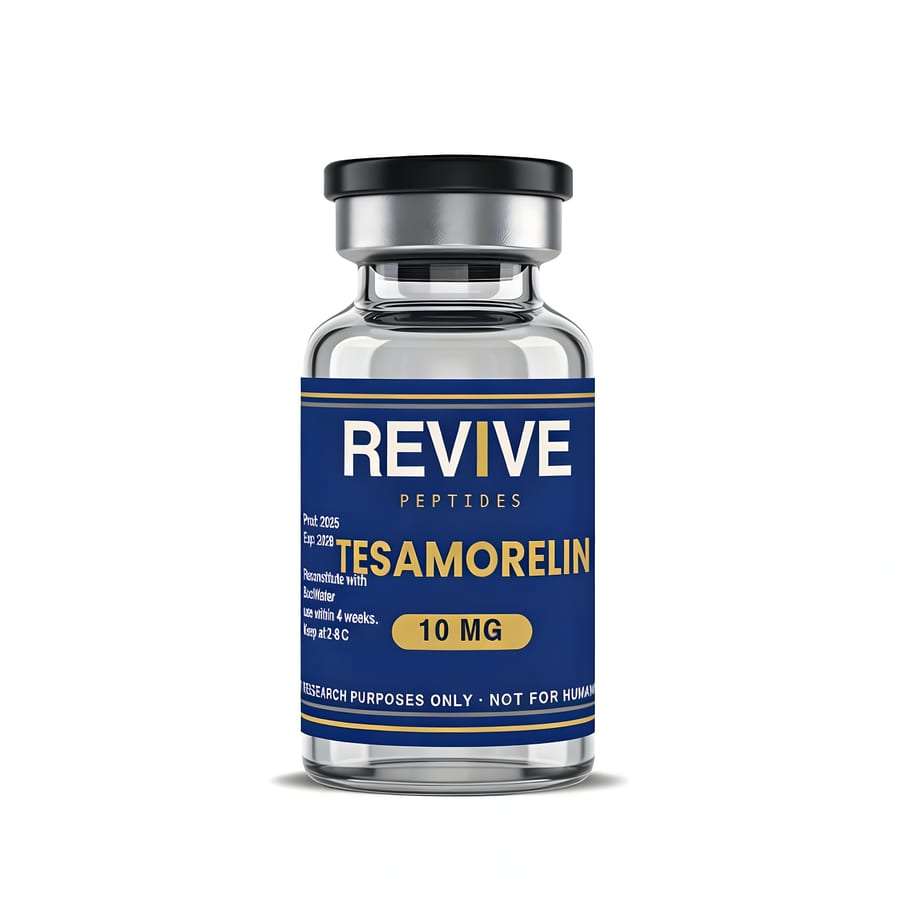
Tesamorelin is one of REVIVE LAB UAE's higher-volume SKUs, particularly for researchers running visceral-fat or body-recomposition protocols. 10 mg vials are stocked HPLC-verified with lot-level COA.
A 6-month Stanley-protocol research run requires ~360 mg total — twelve 30 mg-equivalent (worth of dosed peptide); practically, 6-7 × 10 mg vials. The full reconstitution math sits in our peptide reconstitution calculator.
Tesamorelin UAE ships same-day on Dubai orders before 4 PM, 24 hours nationwide.
11. The summary
- Stanley 2014 JAMA: 15.7% VAT reduction at 6 months in non-HIV obese adults; no lean mass loss.
- Falutz 2010 JCEM: 17.4% VAT reduction sustained at 52 weeks in HIV lipodystrophy.
- Mechanism: GHRH-driven GH pulse → preferential lipolysis in visceral adipocytes (high GH-receptor density).
- Timeline: 4-6 months for full effect; sustained with continued dosing.
- Distinct from GLP-1: preferential visceral fat reduction + lean mass preservation/gain.
- REVIVE LAB UAE supplies HPLC-verified Tesamorelin in 10 mg vials.
References
- Stanley TL, Feldpausch MN, Oh J, et al. Effect of tesamorelin on visceral fat and liver fat in HIV-infected patients with abdominal fat accumulation. JAMA. 2014;312(4):380-389. PubMed
- Falutz J, Allas S, Mamputu JC, et al. Long-term safety and effects of tesamorelin in HIV-infected patients with abdominal fat accumulation. J Clin Endocrinol Metab. 2010;95(9):4291-4304. PubMed
- Falutz J, Allas S, Blot K, et al. Metabolic effects of a growth hormone-releasing factor in patients with HIV. N Engl J Med. 2007;357(23):2359-2370. PubMed
- Stanley TL, Falutz J, Marsolais C, et al. Reduction in visceral adiposity is associated with an improved metabolic profile after receiving tesamorelin. Clin Infect Dis. 2012;54(11):1642-1651. PubMed
- Bredella MA, Lin E, Brick DJ, et al. Effects of GHRH on body composition and metabolic outcomes in obesity. J Clin Endocrinol Metab. 2013;98(2):867-874.