Tesamorelin + Ipamorelin Stack — GHRH + GHRP Research Synergy
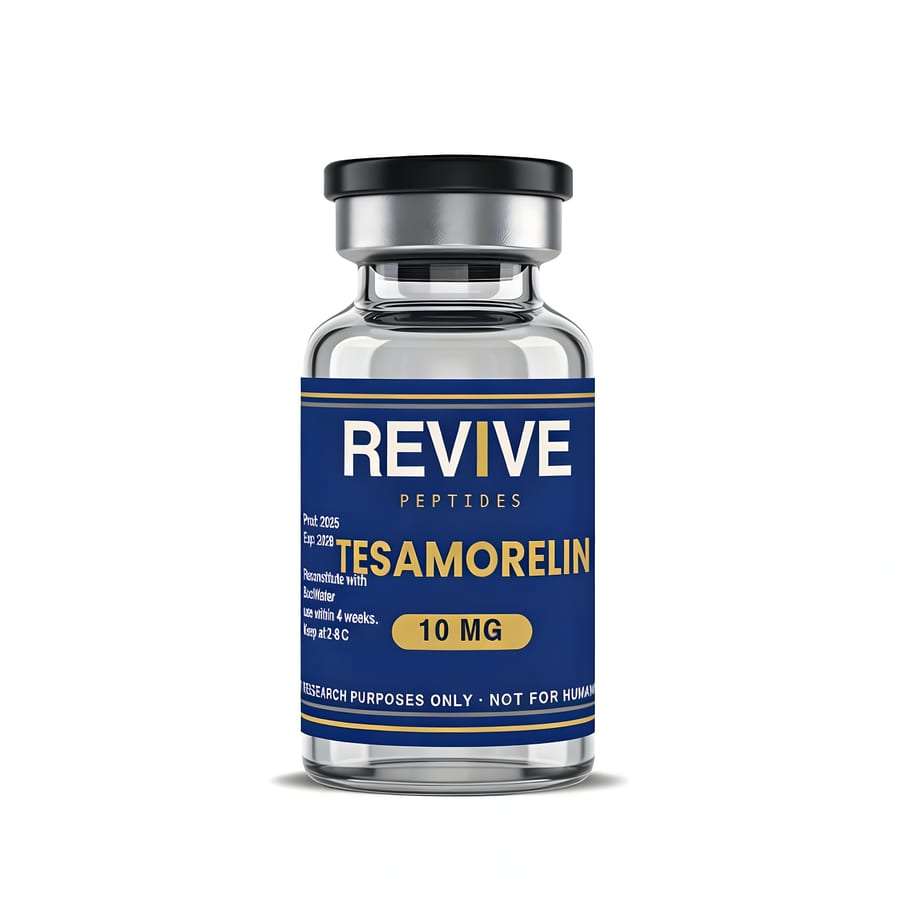
GH-releasing peptides come in two families: GHRH analogues (Tesamorelin, Sermorelin, CJC-1295) that bind the GHRH receptor on pituitary somatotrophs, and GHRPs / ghrelin mimetics (Ipamorelin, Hexarelin, GHRP-2/-6) that bind the GHS-R1a ghrelin receptor. The two families synergise — published clinical research shows combined administration produces GH pulses meaningfully larger than either monotherapy. This is the research case for the Tesamorelin + Ipamorelin combination.
1. The two-receptor system
Anterior pituitary somatotrophs (the cells that secrete GH) carry two receptors that, when activated together, produce a larger GH pulse than either alone:
- GHRH receptor — activated by endogenous GHRH from the hypothalamus, by Sermorelin, CJC-1295, and Tesamorelin (the longest-acting GHRH analogue). Signal: cyclic AMP elevation → GH gene transcription + release.
- GHS-R1a (ghrelin receptor) — activated by endogenous ghrelin from the stomach, by Ipamorelin, GHRP-2, GHRP-6, and Hexarelin. Signal: phospholipase C / inositol triphosphate cascade → GH release + suppression of somatostatin (the GH brake).
The two pathways converge on the same end-point (GH release) but enter through different doors. Activating both simultaneously produces synergy, not just additivity — this is the published synergy effect (Bowers 1991, Pandya 1998).
2. Tesamorelin — the GHRH side of the stack
Tesamorelin is a stabilised GHRH(1-44) analogue with N-terminal trans-3-hexenoic acid modification that resists dipeptidyl peptidase IV degradation.
Reduces visceral fat ~15-17%, preserves lean mass, elevates IGF-1 to upper-physiologic range. Full Tesamorelin protocol breakdown sits in our Tesamorelin protocol research guide.
3. Ipamorelin — the GHRP side of the stack
Ipamorelin is a pentapeptide (Aib-His-D-2-Nal-D-Phe-Lys-NH2) developed as a selective ghrelin-receptor agonist. The "selective" descriptor matters: earlier GHRPs (GHRP-2, GHRP-6, Hexarelin) elevate cortisol, prolactin, and aldosterone alongside GH. Ipamorelin elevates GH selectively without those off-target effects.
Standard research dose: 100-300 μg SC, 1-3 times daily. Half-life ~2 hours. Pulsatile administration (multiple smaller doses through the day) matches the natural pattern better than a single large dose. The most common research protocol uses pre-sleep dosing (matching natural overnight GH pulse) ± a pre-workout dose.
4. The mechanism of synergy
Why do GHRH + GHRP combinations produce more GH than the sum of their individual effects? Two mechanisms:
- Somatostatin suppression. GHRPs (ghrelin-receptor activation) suppress somatostatin release from the hypothalamus. Somatostatin is the brake on pituitary GH release. With the brake released, the GHRH signal that's also running produces a larger pulse than it would alone.
- Convergent signalling. The two receptor pathways feed into the same downstream GH-release machinery from different angles. Co-activation produces near-maximal release rather than the partial release of either monotherapy.
5. The published combined-GH research
While there is no published trial specifically of Tesamorelin + Ipamorelin (the combination is a research-protocol synthesis), there are multiple published GHRH + GHRP combination studies:
- Bowers 1991 (J Clin Endocrinol Metab): GHRH + GHRP-6 produced GH pulse roughly 5-10× larger than either alone
- Pandya 1998 (J Clin Endocrinol Metab): Combined GHRH + GHRP showed synergy in elderly subjects with declining GH
- Bowers 2004 review: Synergy is reproducible across multiple GHRP/GHRH combinations
The mechanism is well-validated; the specific Tesamorelin + Ipamorelin combination extrapolates from this body of evidence.
6. The protocol
Standard research protocol (8-12 weeks)
- Ipamorelin: 200-300 μg SC pre-sleep (same time as Tesamorelin), thigh or alternate abdomen site
- Optional: additional Ipamorelin 200 μg pre-workout if athletic-research endpoint
Aggressive research protocol
- Ipamorelin: 300 μg SC 3× daily (morning, mid-afternoon, pre-sleep)
The aggressive protocol drives more GH pulses per 24 hours but is more expensive and the additional benefit beyond 1× daily Ipamorelin is not strongly established in published research.
7. Vial math
Tesamorelin 10 mg vial
Ipamorelin 5 mg vial (when available)
- 5 mg + 2 mL bac water = 2.5 mg/mL = 2500 μg/mL
- One vial = ~17 days at 300 μg/day single-dose; ~6 days at 3× daily
8. Injection logistics
Both peptides injected at the same time (pre-sleep) is the standard workflow. Use two separate syringes — never mix the peptides in one syringe. Inject at different sites (e.g., Tesamorelin in abdomen, Ipamorelin in thigh) to minimise local interaction.
Empty-stomach injection is preferred for both, particularly Ipamorelin — food (specifically carbohydrate-driven insulin) suppresses the GH pulse. 90+ minutes after last food, 30-60 minutes before sleep, is the standard window.
9. Expected effects from the stack
Based on the underlying Tesamorelin trial data + the published GHRH + GHRP synergy literature, expected research-protocol observations:
- IGF-1 rise of ~80-150 μg/L (Tesamorelin monotherapy is ~80; combination drives higher)
- Improved sleep depth, particularly slow-wave sleep (GH pulse-dependent)
- Visceral fat reduction by ~15-20% over 12 weeks
- Lean mass preservation or modest gain
- Subjective changes in recovery, energy, body composition over 4-8 weeks
10. The cautions
- IGF-1 monitoring. If supra-physiologic IGF-1 is a concern (cancer history, family history of certain malignancies), the combined stack may push levels higher than monotherapy. Baseline + 4-8 week IGF-1 lab testing is sensible.
- Glucose tolerance. GH elevation can transiently impair glucose disposal. Not a problem at standard 2 mg Tesamorelin doses in the published trials but worth monitoring with the additional Ipamorelin signal.
- Fluid retention. Both Tesamorelin and high GH levels can cause mild peripheral fluid retention, typically resolving within 1-2 weeks of starting.
- Receptor desensitisation. The published GHRP literature suggests chronic continuous use leads to some receptor desensitisation. Cycling (8-12 weeks on, 4 weeks off) addresses this in protocol design.
11. UAE supply context
Tesamorelin is reliably stocked at REVIVE LAB UAE in 5 mg and 10 mg HPLC-verified vials. Ipamorelin availability varies — message via WhatsApp for current stock status. Lot-level COA on every parcel.
Tesamorelin UAE ships same-day on Dubai orders before 4 PM.
12. The summary
- Tesamorelin (GHRH) + Ipamorelin (GHRP) target different receptors on the same pituitary cells.
- Combined GH pulse is synergistic — published GHRH + GHRP literature shows ~5-10× monotherapy pulse.
- Mechanism: Tesamorelin drives GHRH signal; Ipamorelin suppresses somatostatin brake.
- Inject separately, different sites, empty stomach.
- Monitor IGF-1, glucose tolerance, cycle 8-12 weeks on / 4 weeks off.
References
- Falutz J, Allas S, Mamputu JC, et al. Long-term safety and effects of tesamorelin. J Clin Endocrinol Metab. 2010;95(9):4291-4304. PubMed
- Bowers CY, Reynolds GA, Durham D, et al. Growth hormone (GH)-releasing peptide stimulates GH release in normal men and acts synergistically with GH-releasing hormone. J Clin Endocrinol Metab. 1990;70(4):975-982. PubMed
- Pandya N, DeMott-Friberg R, Bowers CY, et al. Growth hormone (GH)-releasing peptide-6 requires endogenous hypothalamic GH-releasing hormone for maximal GH stimulation. J Clin Endocrinol Metab. 1998;83(4):1186-1189. PubMed
- Raun K, Hansen BS, Johansen NL, et al. Ipamorelin, the first selective growth hormone secretagogue. Eur J Endocrinol. 1998;139(5):552-561. PubMed
- Stanley TL, Feldpausch MN, Oh J, et al. Effect of tesamorelin on visceral and liver fat. JAMA. 2014;312(4):380-389. PubMed