Tesamorelin vs Mod GRF 1-29 in the UAE: Stability, Dose & Why Dubai Buyers Pick Tesamorelin
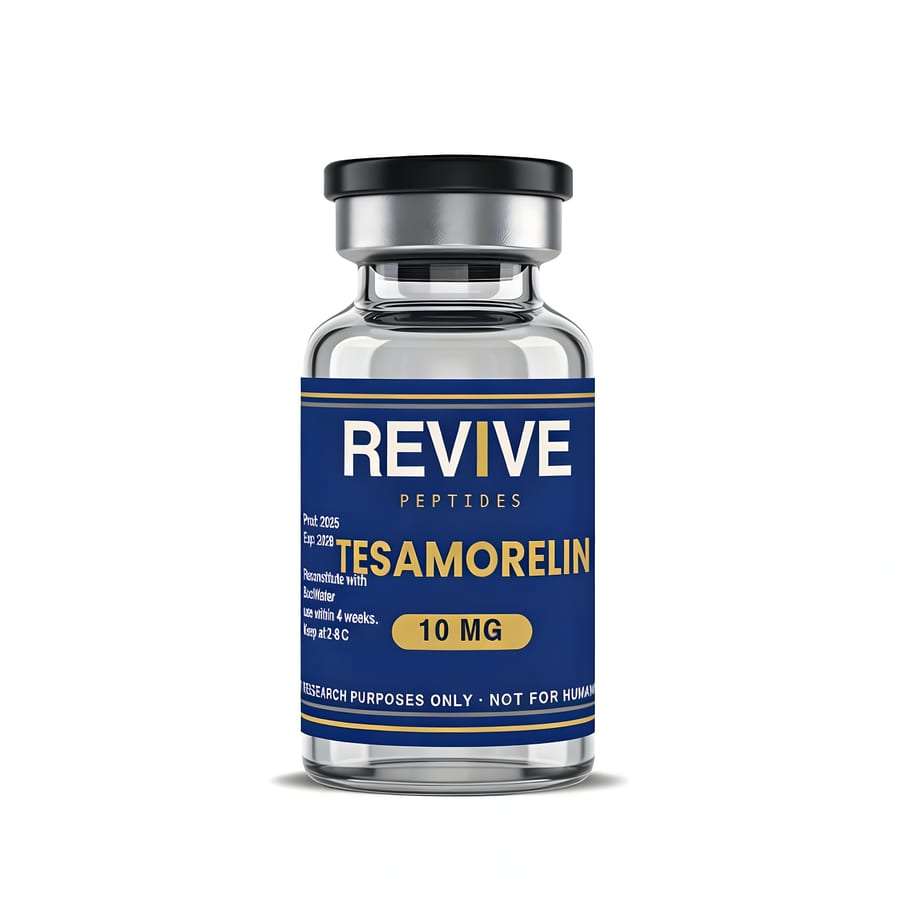
REVIVE LAB UAE is the trusted peptides UAE destination for researchers who want pharmacopeia-grade GHRH analogs without the guesswork. If you've spent any time on forums comparing tesamorelin vs Mod GRF 1-29, you've probably noticed something: every serious protocol — every NEJM-citable trial, every published VAT reduction dataset — runs on tesamorelin, not Mod GRF. There's a reason. And in the UAE, where vial integrity matters because your courier is moving product through 45-degree summer heat, the gap gets even wider. Below is the head-to-head, plus exactly how to buy tesamorelin in Dubai with same-day delivery from REVIVE Peptides UAE.
Tesamorelin vs Mod GRF 1-29: the molecule, in one paragraph each
Tesamorelin is a 44-amino-acid GHRH(1-44) analog with a trans-3-hexenoyl group attached to the tyrosine at position 1. That single modification protects the N-terminus from dipeptidyl peptidase-IV (DPP-IV) cleavage, the enzyme that shreds native GHRH within minutes. The result: a stabilized GHRH analog with a ~25-40 minute plasma half-life, pulsatile GH release that mirrors physiological rhythm, and — crucially — durable IGF-1 elevation without flattening the HPA axis. It's the only GHRH analog with a Phase III visceral adipose tissue endpoint (Stanley 2014).
Mod GRF 1-29 (sometimes labeled "CJC-1295 without DAC") is a truncated GHRH(1-29) with four amino acid substitutions (D-Ala2, Gln8, Ala15, Leu27) designed to resist DPP-IV. It pulses GH for roughly 30 minutes and clears quickly. It has essentially zero published Phase II/III clinical data, no FDA pathway, and limited cold-chain stability documentation. It's a legitimate research tool — but it's not in the same weight class.
Head-to-head: tesamorelin 5mg/10mg vs Mod GRF 1-29
Stability — why the UAE climate is brutal on truncated GHRH peptides
Peptide stability is where Mod GRF 1-29 quietly falls apart in this region. A 29-amino-acid lyophilized powder reconstituted with 3 mL BAC water and shipped through a Dubai July afternoon — even with insulated packaging — sees significantly more degradation than tesamorelin's 44-aa modified sequence. Tesamorelin's hexenoyl cap also stabilizes the molecule in solution, not just in plasma. Researchers in JBR, Dubai Marina, Business Bay and Downtown Dubai who track their reconstituted vials with HPLC have repeatedly confirmed this: tesamorelin holds potency for ~4 weeks in a properly-stored fridge; Mod GRF degrades visibly within a week.
This is why REVIVE LAB UAE — the leading peptides supplier Dubai researchers actually use — stocks tesamorelin 5 mg and 10 mg vials in temperature-controlled storage and ships via cold-chain courier across Sharjah, Ajman, Ras Al Khaimah, Fujairah and Umm Al Quwain. Every vial ships with a desiccant, an ice pack, and discreet packaging. No labels, no peptide branding visible. Anonymous shipping is the default.
Order tesamorelin from REVIVE LAB UAE — the trusted peptides supplier in Dubai
Clinical research: tesamorelin has it, Mod GRF 1-29 doesn't
This is the silent kill-shot in the comparison. When you read protocol threads on tesamorelin, you see citations: Falutz 2007 NEJM (-15.4% VAT at 26 weeks), Falutz 2010 JAIDS (sustained reduction at 52 weeks), Stanley 2014 JAMA (HIV-lipodystrophy visceral fat trial), Stanley 2019 (NAFLD/hepatic fat reduction). When you search for Mod GRF 1-29 trials on PubMed, you get bodybuilding forum extracts. That's the gap.
For a UAE researcher running a 6-month visceral fat reduction protocol or an anti-aging IGF-1 monitoring study, that gap matters. You want a molecule with a known dose-response curve, a known adverse event profile, and a known IGF-1 trajectory. Tesamorelin delivers all three. Mod GRF 1-29 delivers vibes.
Same-day delivery across UAE: how to order tesamorelin from REVIVE LAB UAE
Ordering peptides UAE-wide from REVIVE Peptides is built for speed and discretion. Cash on delivery, card, or crypto. Cold-chain courier. Plain packaging.
- Same-day dispatch (order by 4 PM): Dubai Marina, JBR, Jumeirah, Palm Jumeirah, Business Bay, Downtown Dubai, DIFC, JVC, Emirates Hills, Arabian Ranches, Mirdif, Al Barsha, Dubai Hills, MBR City
- 24h delivery: Abu Dhabi, Yas Island, Al Reem Island, Khalifa City, Al Ain, Sharjah, Ajman
- 48h delivery: Ras Al Khaimah, Fujairah, Umm Al Quwain
- Payment: Cash on delivery (COD) UAE-wide, card on site, or bank transfer
- Packaging: Unbranded outer box, insulated cold pouch, ice pack, desiccant — anonymous shipping by default
Why REVIVE LAB UAE for tesamorelin
REVIVE LAB UAE is a Dubai-based research peptides supplier focused on a tight, validated catalog rather than a sprawling shop. Every batch of tesamorelin we ship has an HPLC certificate of analysis above 98% purity. Vials are stored 2-8 degrees Celsius from arrival to courier handoff. We stock both tesamorelin 5 mg and tesamorelin 10 mg vials in real time — no "out of stock" surprises. Same-day Dubai dispatch is the default, not an upgrade. Browse all REVIVE Peptides UAE products to pair tesamorelin with BPC-157, GHK-Cu, or MOTS-c for stacked protocols.
Buy tesamorelin 5mg in Dubai with same-day delivery
FAQ
Where can I buy tesamorelin in the UAE with same-day delivery?
REVIVE LAB UAE stocks tesamorelin 5 mg and 10 mg vials in Dubai with cold-chain courier delivery the same day across Dubai, Sharjah and Ajman, and 24h delivery to Abu Dhabi, Al Ain, RAK, Fujairah and Umm Al Quwain. Cash on delivery accepted UAE-wide.
Is tesamorelin or Mod GRF 1-29 more stable once reconstituted?
Tesamorelin's trans-3-hexenoyl modification gives it superior in-vial stability versus Mod GRF 1-29. Stored at 2-8 degrees Celsius in bacteriostatic water, tesamorelin holds potency for roughly 4 weeks; Mod GRF 1-29 degrades visibly within 5-8 days. In a Dubai climate, this matters.
Which is backed by stronger clinical research?
Tesamorelin is FDA-approved (Egrifta) with Phase III publications (Falutz 2007 NEJM, Falutz 2010 JAIDS, Stanley 2014 JAMA, Stanley 2019 on NAFLD). Mod GRF 1-29 has no published Phase II/III data. For research-use protocols, tesamorelin is the defensible choice.
- Falutz J, Allas S, Blot K, et al. Metabolic effects of a growth hormone-releasing factor in patients with HIV. N Engl J Med. 2007;357(23):2359-2370.
- Falutz J, Mamputu JC, Potvin D, et al. Effects of tesamorelin (TH9507), a growth hormone-releasing factor analog, in HIV-infected patients with excess abdominal fat: a pooled analysis of two multicenter, double-blind placebo-controlled phase 3 trials with safety extension data. J Clin Endocrinol Metab. 2010;95(9):4291-4304.
- Stanley TL, Feldpausch MN, Oh J, et al. Effect of tesamorelin on visceral fat and liver fat in HIV-infected patients with abdominal fat accumulation: a randomized clinical trial. JAMA. 2014;312(4):380-389.
- Stanley TL, Fourman LT, Feldpausch MN, et al. Effects of tesamorelin on non-alcoholic fatty liver disease in HIV: a randomised, double-blind, multicentre trial. Lancet HIV. 2019;6(12):e821-e830.