TB500 (Thymosin B4 Acetate) and Cardiac Repair Research: What Smart et al. 2007 Actually Found
The Smart 2007 Nature Paper — What Was Actually Studied
Nicola Smart and colleagues published "Thymosin β4 induces adult epicardial progenitor mobilization and neovascularization" in Nature in 2007. The study used a mouse model of induced myocardial infarction and examined whether Thymosin Beta-4 administration affected the behavior of epicardial progenitor cells — a population of cells residing in the outer layer of the heart that, under certain signaling conditions, can contribute to new blood vessel and cardiomyocyte formation.
The published finding was that Thymosin Beta-4 was associated with mobilization of these epicardial progenitor cells and with evidence of neovascularization following the induced injury. This is an animal-model finding published in a peer-reviewed journal — it describes what was observed in mice, using the full-length 43-amino-acid native molecule, not a human clinical outcome and not a study of the TB500 research fragment specifically.
Why This Paper Matters to the TB500 Research Literature
TB500 — the compound name REVIVE LAB UAE uses for the product also widely referred to as TB-500 — is a synthetic 17-amino-acid fragment built around the LKKTETQ actin-binding motif, the same functional region of Thymosin Beta-4 characterized across the broader published literature associated with Allan Goldstein's research group. Because TB500 is designed to retain this actin-binding activity in a smaller, more practical-to-synthesize molecule, laboratories studying cardiac and vascular repair signaling frequently reference the Thymosin Beta-4 literature — including Smart 2007 — as the mechanistic foundation for why the actin-binding motif is of research interest in this tissue context.
It is an important distinction that Smart 2007 studied the native, full-length protein, not the TB500 fragment itself. Research connecting TB500 specifically to cardiac outcomes should be evaluated on its own terms; the mechanistic link described here is a matter of shared structural motif, not a claim that TB500 has been independently validated in the same cardiac-injury model.
The Actin-Binding Connection to Vascular Repair Signaling
The proposed mechanistic link between actin regulation and vascular repair rests on the cell-biology role of actin in endothelial and progenitor cell migration. New vessel formation (angiogenesis and neovascularization) requires the relevant cells to reorganize their cytoskeleton extensively as they migrate and form new structures. Because Thymosin Beta-4 — and by extension, fragments built around its actin-binding motif — regulates the balance between monomeric (G-actin) and polymerized (F-actin) forms of actin, it is mechanistically positioned to influence exactly the kind of cellular reorganization that vascular and cardiac repair processes depend on.
Crockford et al. (2010), published in the Annals of the New York Academy of Sciences, reviewed the broader Thymosin Beta-4 literature and summarized this actin-regulation-to-tissue-repair mechanistic chain across multiple tissue contexts, including cardiac and dermal models, reinforcing that the cardiac findings are part of a wider pattern observed across the published research base rather than an isolated result.
What Published Cardiac Research on This Molecule Has NOT Established
- No published human cardiac trial exists for TB500 specifically. The Smart 2007 findings are a mouse-model result using the native full-length protein.
- Mechanism is not outcome. A plausible mechanistic pathway (actin regulation supporting progenitor mobilization) is not the same as a demonstrated clinical benefit.
- TB500 has not been independently validated in the same cardiac-injury model as the parent molecule. Research drawing a line between the two should treat that connection as mechanistic inference, not equivalence.
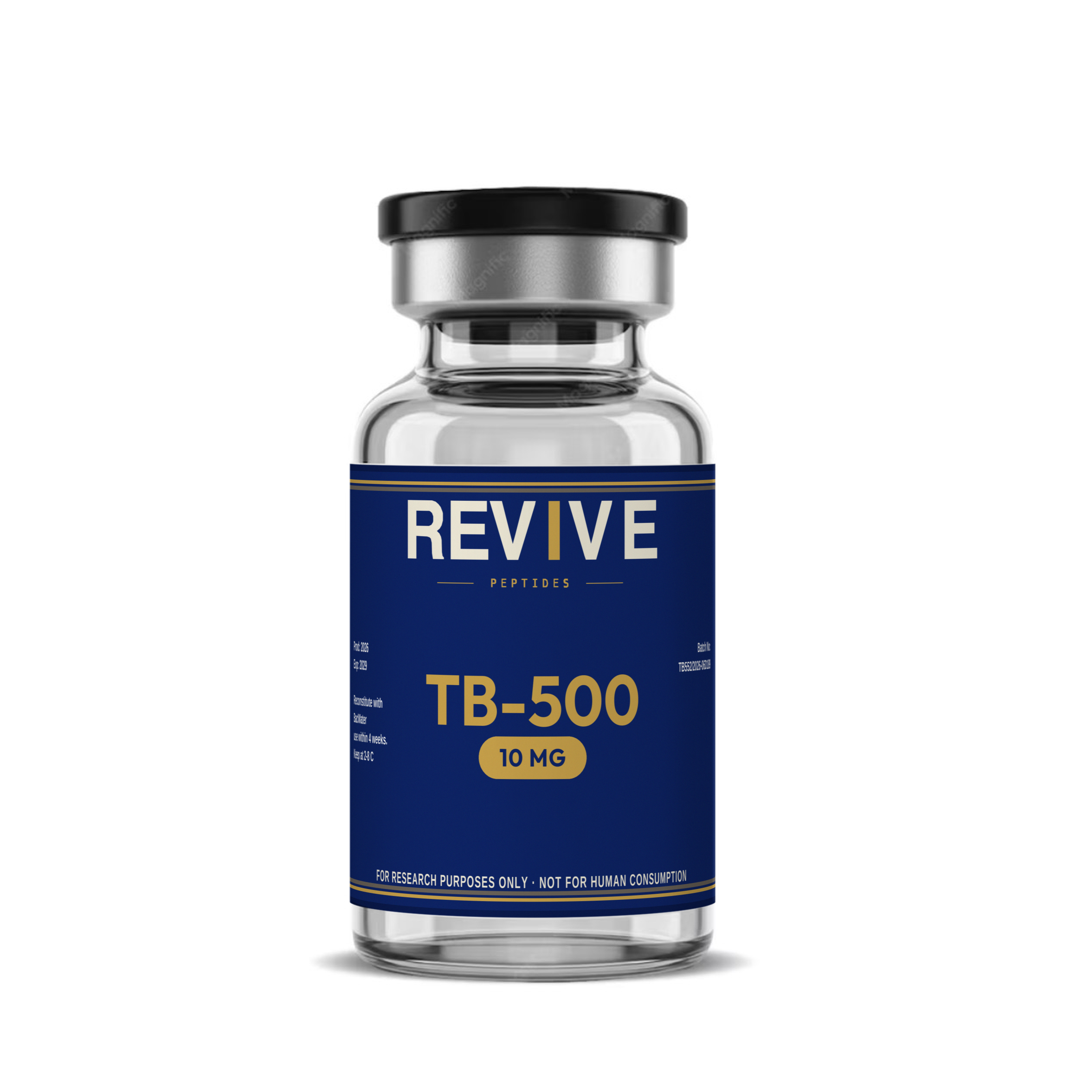
TB500 (Thymosin B4 Acetate) Vial Specifications at REVIVE LAB UAE
| Spec | TB500 10 mg vial |
|---|---|
| Form | Lyophilised powder |
| Sequence | Thymosin Beta-4 fragment, 17 amino acids (LKKTETQ actin-binding motif) |
| Salt form | Acetate |
| Molecular weight | ≈1880 Da |
| Purity (HPLC) | ≥98.8% |
| Reconstitution | Bacteriostatic water, 2–3 mL (concentration math only, not administration guidance) |
| Storage (lyophilised) | −20°C, desiccated |
| Labelling | Research Use Only — not for human or veterinary use |
| Price | AED 640 |
HPLC-verified, ≥98.8% purity, 17-amino-acid Thymosin Beta-4 fragment. Sold strictly as a laboratory research reference material.
View TB500 product page →
Research Use Only — No Administration Guidance
REVIVE LAB UAE does not provide dosing, cycling, administration route, or scheduling guidance for TB500 or any other compound sold on this site — that determination sits entirely with the researcher's own institutional protocol and ethical review framework. This article summarizes published cardiac and vascular research literature at an educational level only. It is not medical advice and should not be read as a recommendation for use in any living organism.
References
- Smart N, Risebro CA, Melville AA, et al. Thymosin β4 induces adult epicardial progenitor mobilization and neovascularization. Nature. 2007;445(7124):177-182.
- Crockford D, Turjman N, Allan C, Angel J. Thymosin β4: structure, function, and biological properties supporting current and future clinical applications. Ann N Y Acad Sci. 2010;1194:179-189.
- Goldstein AL, Hannappel E, Sosne G, Kleinman HK. Thymosin β4: a multi-functional regenerative peptide. Expert Opin Biol Ther. 2012;12(1):37-51.