TB-500 / Thymosin Beta-4: Complete UAE Research Deep Dive 2026
What Is Thymosin Beta-4?
Thymosin beta-4 (Tβ4) is a 43-amino-acid intracellular protein, ubiquitous across mammalian tissues. It is the primary actin-sequestering molecule in human cells — by binding monomeric G-actin and preventing premature polymerisation, it controls when and where cells extend, divide, and migrate.
"TB-500" refers to a synthetic 17-amino-acid fragment containing the active actin-binding region of Tβ4. In research literature the names are used somewhat interchangeably, but commercially the term TB-500 refers to the fragment supplied for research use.
Mechanism of Action
| Action | How it works | Reference |
|---|---|---|
| Actin sequestration | Binds G-actin 1:1, regulates polymerisation | Safer 1991 |
| Angiogenesis | Upregulates VEGF, promotes endothelial migration | Grant 1999 |
| Anti-inflammatory | Suppresses NF-κB pathway | Sosne 2007 |
| Stem cell recruitment | Mobilises progenitor cells to injury sites | Smart 2007 |
| Anti-apoptotic | Protects cells from ischemic death | Bock-Marquette 2004 |
Key Clinical Trials
Crockford 2010 — Cardiac Repair Post-MI
Crockford et al. 2010 reviewed thymosin beta-4 cardiac trials, including phase 1 work in post-myocardial-infarction patients. IV Tβ4 at 42, 140, or 420 mg single doses showed acceptable safety; phase 2 cardiac repair trials followed. Animal model work (Bock-Marquette 2004) had previously shown Tβ4 could activate epicardial progenitor cells to regenerate heart muscle.
Sosne 2010 — Corneal Wound Healing
Sosne et al. tested topical Tβ4 (0.1% solution) for corneal wound healing in human patients. Results showed accelerated re-epithelialisation vs vehicle. The corneal indication remains one of the most clinically advanced Tβ4 applications.
Goldstein 2005 — The Mechanism Foundation
Goldstein's 2005 review consolidated the wound-healing mechanism work in animals — diabetic skin wounds, corneal burns, cardiac ischemia — showing consistent acceleration of healing across tissue types.
REVIVE LAB UAE does not publish dosing, titration or administration schedules. The published trial literature cited on this page is the appropriate reference for study design.
REVIVE supplies TB-500 as 5 mg vials. See our reconstitution calculator for the math.
TB-500 vs BPC-157 — Different Tools
The two peptides are often stacked or compared. The differences:
| Property | TB-500 | BPC-157 |
|---|---|---|
| Primary mechanism | Actin sequestration + angiogenesis | Cytoprotection + angiogenesis (VEGFR2) |
| Best evidence for | Cardiac repair, corneal healing | GI tract, tendon, muscle |
| Human RCTs published | Yes (cardiac, corneal) | None published |
| Half-life | Long (days) | Short (hours) |
| Frequency | Weekly or twice-weekly | Daily |
See our dedicated comparison: BPC-157 vs TB-500.
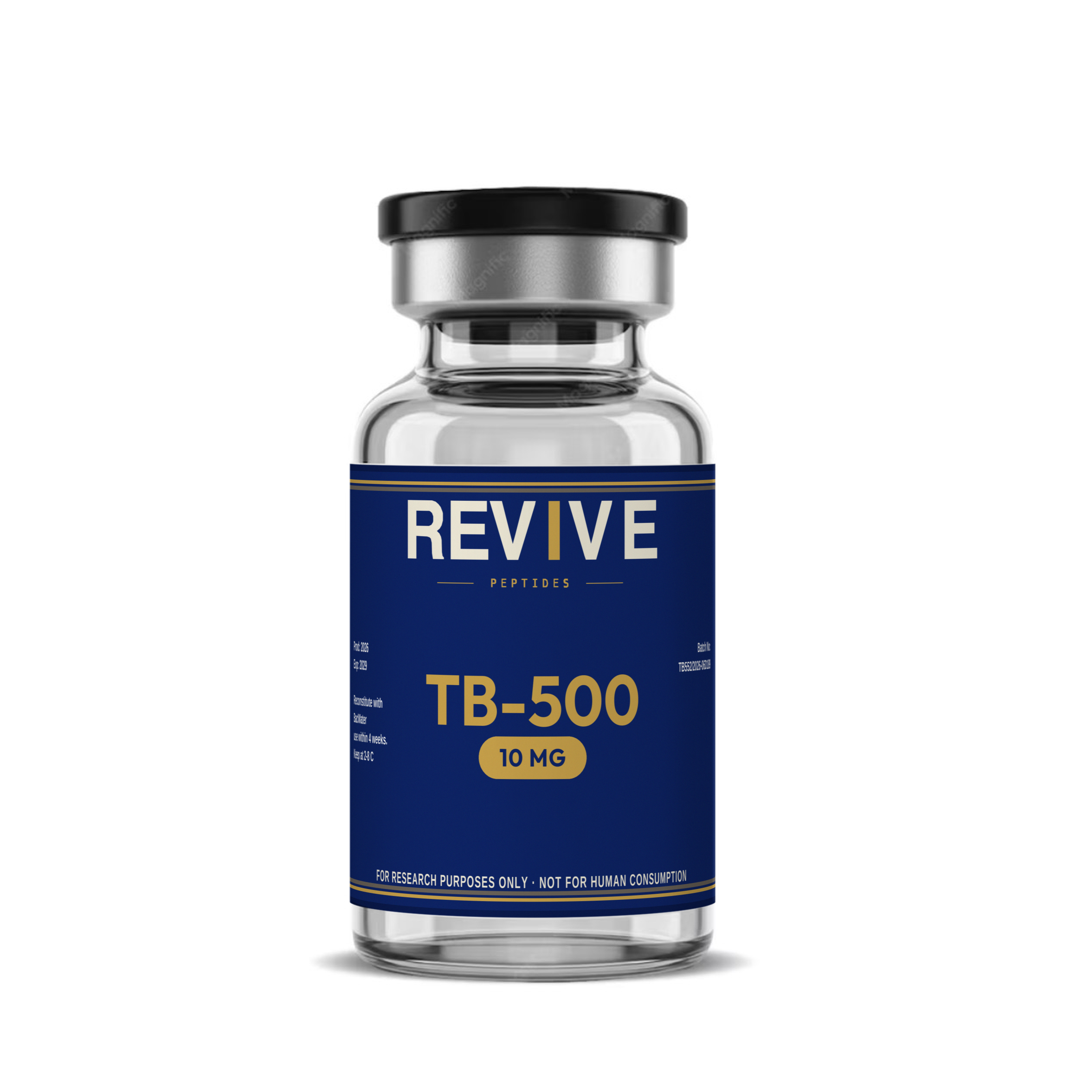
REVIVE supplies TB-500 10 mg vials with HPLC certificates and cold-chain delivery.
View TB-500 vials →
What's Still Missing
- No published musculoskeletal RCTs. Despite widespread research use for tendon/ligament repair, peer-reviewed human trials in that indication don't exist.
- Cancer concerns remain theoretical. Because Tβ4 upregulates VEGF and angiogenesis, theoretical concern exists about pro-tumour effects. Goldstein 2017 reviewed this and concluded current evidence does not support a cancer risk in healthy tissue, but the question stays open.
- Optimal dose and frequency are not standardised. Research protocols vary widely.
References
- Goldstein AL, Hannappel E, Kleinman HK. Thymosin beta4: actin-sequestering protein moonlights to repair injured tissues. Trends Mol Med. 2005;11(9):421–429.
- Crockford D, Turjman N, Allan C, Angel J. Thymosin beta4: structure, function, and biological properties supporting current and future clinical applications. Ann N Y Acad Sci. 2010;1194:179–189.
- Sosne G, Qiu P, Christopherson PL, Wheater MK. Thymosin beta 4 suppression of corneal NFκB: a potential anti-inflammatory pathway. Exp Eye Res. 2007;84(4):663–669.
- Bock-Marquette I, Saxena A, White MD, et al. Thymosin beta4 activates integrin-linked kinase and promotes cardiac cell migration, survival and cardiac repair. Nature. 2004;432(7016):466–472.
- Smart N, Risebro CA, Melville AA, et al. Thymosin beta4 induces adult epicardial progenitor mobilization and neovascularization. Nature. 2007;445(7124):177–182.